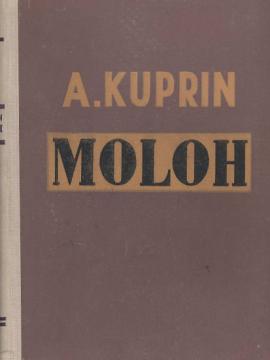
Moloh

Moloh

Aleksandar Kuprin

This novel sharply criticizes the rapidly growing Russian capitalism and reflects the growing industrial unrest in the country, and is considered Kuprin's debut.

The plot follows engineer Andrej Bobrov, who works for a ruthless capitalist industrial enterprise and is increasingly uncomfortable with what is happening around him. After losing Nina, the woman he loves, at the hands of the immoral industrialist Kvašnin, the owner of that company, he experiences a nervous breakdown and remains a broken man, prone to frenetic and fruitless discussions with his own "doppelganger". The end of the story suggests the outbreak of a workers' uprising.

Some of the key characters in the novel are:

  • Andrey Bobrov: A sensitive and socially conscious man who recognizes the factory where he works as an insatiable Moloch, the ruthless Ammonite god for whom children were "passed through fire" in ritual sacrifice (2 Kings 23:10).
  • Kvashnin: The owner of the company, "greedy, lecherous, monstrously fat", whom Bobrov sees as the personification of "industrial immorality".
  • Svezhevsky: Disgusting careerist, "modern Uriah Heep" (Nicholas Luker).
  • Zinenko: The man in charge of warehouses in the factory; he bullies his superiors, gossips about his colleagues and tyrannizes his subordinates.
  • Nina: Zinenko's daughter, a beautiful young woman with whom Bobrov falls in love and who is more impressed by Kvashnin's wealth. She should marry Svezhevsky to become Kvashnin's mistress under the guise of respectability.
  • Goldberg: The doctor at the factory and Beaver's only friend.
  • Andrea: A well-educated and extremely intelligent Belgian engineer. The novel "Moloch" is deeply rooted in the social and economic problems of the 1890s, reflecting the growing unrest among the new working class. Kuprin successfully conveyed the tension and conflicts of that time in his work.

Although the novel was written more than a century ago, its subject matter still has relevance in the contemporary context.

Prevod
Jakša Kušan
Dimenzije
19,5 x 14,5 cm
Broj strana
240
Izdavač
Glas rada, Zagreb, 1951.
 
Latinica. Tvrde korice.
Jezik: Hrvatski.

Jedan primerak je u ponudi

Stanje:Korišćeno, u odličnom stanju
Oštećenja / nepogodnosti:
  • Traces of patina
Dodato u korpu!
 

Zanima Vas i neka druga knjiga? Možete pretražiti našu ponudu pomoću pretrage ili prelistati knjige po kategorijama.

Možda će Vas zanimati i ovi naslovi

Kvaka braka

Kvaka braka

Melanie Gideon

Melanie Gideon, an American writer known for her humorous novels about family dynamics, dissects the monotony of marriage in the age of social media in The Marriage Trap (2012).

Algoritam, 2013.
Hrvatski. Latinica. Broširano.
7,36
Aurorin poticaj

Aurorin poticaj

Erich Hackl

The work is based on a true event that occurred in Spain in 1933: Aurora Rodriguez killed her daughter Hildegart, a famous fighter for women's emancipation and a cult figure on the political scene of the time.

Mladost, 1990.
Hrvatski. Latinica. Tvrde korice s omotom.
4,963,72 - 4,98
Operater

Operater

B. D. Benedict

The novel by Serbian-Canadian author Božidar D. Benedict (film director and author of 36 bestsellers) is a pioneering example of the "religious thriller" – a genre invented by Benedict, where instead of spies, invisible agents of God and Satan fight for h

Stari grad, 2000.
Hrvatski. Latinica. Tvrde korice.
9,227,38 - 9,26
Svjedokinja

Svjedokinja

Nora Roberts

Nora Roberts, the queen of romantic thrillers, in Witness (2012) combines the tension of a mafia showdown with an emotional story of survival and love. A bestseller full of heart and adrenaline.

Profil Knjiga, 2014.
Hrvatski. Latinica. Broširano.
7,365,52
Zvezde su tamne

Zvezde su tamne

Peter Cheyney

"The stars are dark" is a spy thriller by the British writer Peter Cheyney, known for fast, tense stories and hard-boiled characters.

Svjetlost, 1965.
Srpski. Latinica. Broširano.
2,96 - 3,26
Deobe 1-3

Deobe 1-3

Dobrica Ćosić

This work, awarded the NIN Prize for that year, is considered one of the most significant in Serbian literature after World War II.

Prosveta, 1961.
Srpski. Ćirilica. Tvrde korice s omotom.
Knjiga se sastoji od tri toma
11,42