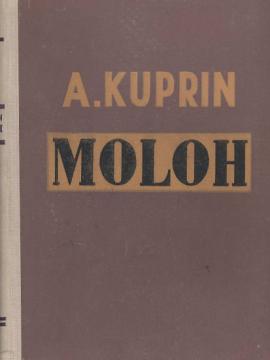
Moloh

Moloh

Aleksandar Kuprin

This novel sharply criticizes the rapidly growing Russian capitalism and reflects the growing industrial unrest in the country, and is considered Kuprin's debut.

The plot follows engineer Andrej Bobrov, who works for a ruthless capitalist industrial enterprise and is increasingly uncomfortable with what is happening around him. After losing Nina, the woman he loves, at the hands of the immoral industrialist Kvašnin, the owner of that company, he experiences a nervous breakdown and remains a broken man, prone to frenetic and fruitless discussions with his own "doppelganger". The end of the story suggests the outbreak of a workers' uprising.

Some of the key characters in the novel are:

  • Andrey Bobrov: A sensitive and socially conscious man who recognizes the factory where he works as an insatiable Moloch, the ruthless Ammonite god for whom children were "passed through fire" in ritual sacrifice (2 Kings 23:10).
  • Kvashnin: The owner of the company, "greedy, lecherous, monstrously fat", whom Bobrov sees as the personification of "industrial immorality".
  • Svezhevsky: Disgusting careerist, "modern Uriah Heep" (Nicholas Luker).
  • Zinenko: The man in charge of warehouses in the factory; he bullies his superiors, gossips about his colleagues and tyrannizes his subordinates.
  • Nina: Zinenko's daughter, a beautiful young woman with whom Bobrov falls in love and who is more impressed by Kvashnin's wealth. She should marry Svezhevsky to become Kvashnin's mistress under the guise of respectability.
  • Goldberg: The doctor at the factory and Beaver's only friend.
  • Andrea: A well-educated and extremely intelligent Belgian engineer. The novel "Moloch" is deeply rooted in the social and economic problems of the 1890s, reflecting the growing unrest among the new working class. Kuprin successfully conveyed the tension and conflicts of that time in his work.

Although the novel was written more than a century ago, its subject matter still has relevance in the contemporary context.

Translation
Jakša Kušan
Dimensions
19.5 x 14.5 cm
Pages
240
Publisher
Glas rada, Zagreb, 1951.
 
Latin alphabet. Hardcover.
Language: Croatian.

One copy is available

Condition:Used, excellent condition
Damages or inconvenience notice:
  • Traces of patina
 

Are you interested in another book? You can search the offer using our search engine or browse books by category.

You may also be interested in these titles

O čemu ne govorimo

O čemu ne govorimo

Slavenka Drakulić

Can you face the taboos of modern society? Old age, illness, weakness. Slavenka Drakulić bravely enters into topics we are reluctant to talk about.

Fraktura, 2024.
Croatian. Latin alphabet. Hardcover with dust jacket.
14.62
Drugi Ajnštajn

Drugi Ajnštajn

Mari Benedikt

"A novel that reveals to you the secrets of Mileva's heart, her thoughts and the passionate spirit of a scientist - a woman fighting for her place in the world of science ruled by men."

Laguna, 2019.
Serbian. Latin alphabet. Paperback.
5.98
Posljednji dani panka

Posljednji dani panka

Gordan Nuhanović

A generational novel set in the late 1990s, in provincial Croatia. The main character, a thirty-five-year-old journalist in a deep professional and existential crisis, returns from Zagreb to his hometown after years of working in sensationalist media.

Profil Knjiga, 2006.
Croatian. Latin alphabet. Paperback.
9.54
Koncert za tequilu i apaurin

Koncert za tequilu i apaurin

Edo Popović

A short novel by Edo Popović, one of the most important Croatian prose writers of the 1990s and 2000s. The book is part of Popović's "Zagreb Cycle" – a critique of transition without pathos, but through absurdity and grotesqueness.

Meandar, 2003.
Croatian. Latin alphabet. Paperback.
3.26
Pažnja

Pažnja

Alberto Moravia

Francesco Merighi returns to Rome after 9 years abroad. In order to write an "authentic" novel, he keeps a diary of his life with his wife and their daughter Babe. He obsessively analyzes lies in relationships, the temptation of

Otokar Keršovani, 1966.
Croatian. Latin alphabet. Hardcover.
3.96
Svjetlost se ugasila

Svjetlost se ugasila

Rudyard Kipling

The first novel by English Nobel Prize winner Rudyard Kipling (1865–1936), first published in Lippincott's Monthly Magazine (happy ending variant), and then in a book version with a tragic ending.

Zora, 1957.
Croatian. Latin alphabet. Hardcover with dust jacket.
5.42