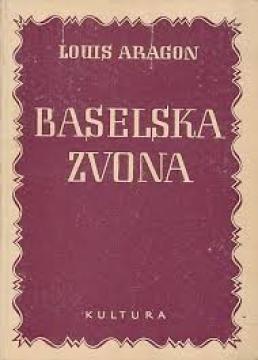
Baselska zvona
Retka knjiga

Baselska zvona

Louis Aragon

The novel follows three women: Diane, a noblewoman; Catherine Simonidzé, a feminist; and the real Clara Zetkin, a communist. Through their destinies, the crisis of bourgeois society, women's emancipation, and the path to communism are depicted.

The Bells of Basel is the first novel in the cycle Le Monde réel (The Real World) by Louis Aragon, published in 1934 (revised in 1964), in which Aragon moves from surrealism to socialist realism and Marxist criticism of society. The title alludes to the bells of Basel – symbolic of the alarm for the awakening of the working class and the end of the bourgeois world, and to the International Congress of Women in Basel in 1912.

The novel is divided into three main parts, each focusing on a single woman:

  • Diane – an aristocrat from a failed noble family, who lives off "rich fiancés" and uses sexuality as power. Her son Guy observes the adult world cynically and satirically – the first part is a comedy of manners, a critique of bourgeois decadence and hypocrisy.
  • Catherine Simonidzé – a young Georgian, the daughter of an oil magnate from Baku, who lives in Paris on her father's checks. She starts out as an anarchist, gets involved in labor movements (taxi strike), falls in love with Victor (a striker), but realizes the limitations of individual rebellion. Her path leads from anarchism to socialism.
  • Clara Zetkin – a real historical figure, German socialist militant and feminist (founder of International Women's Day). She represents the ideal of a revolutionary – dedicated to class struggle, women's emancipation and internationalism.

Through these women's destinies, Aragon dissects pre-war Europe (early 20th century): bourgeois decay, the crisis of patriarchy, women's oppression, class conflicts and the path to revolution. The novel begins satirically and cynically (as a critique of the bourgeoisie), and ends lyrically and idealistically – in communist hope. It is a "thesis novel" that shows how women, of different classes and ideologies, come to the realization that true emancipation is possible only in the socialist struggle.

The style is realistic with elements of lyricism and irony - Aragon uses documentary motifs (strikes, congresses), but also the psychological depth of the characters. The work is important for Aragon's conversion to communism (he became a member of the PCF in 1927) and influenced French left-wing literature in the 30s.

Naslov originala
Les Cloches de Bâle
Prevod
Vinko Tecilazić
Dimenzije
19,5 x 14 cm
Broj strana
331
Izdavač
Kultura, Beograd, 1946.
 
Latinica. Tvrde korice.
Jezik: Srpski.

Jedan primerak je u ponudi

Stanje:Korišćeno, u vrlo dobrom stanju
Oštećenja / nepogodnosti:
  • Damaged back
Dodato u korpu!
 

Zanima Vas i neka druga knjiga? Možete pretražiti našu ponudu pomoću pretrage ili prelistati knjige po kategorijama.

Možda će Vas zanimati i ovi naslovi

Inka - kraljevna sunca

Inka - kraljevna sunca

Antoine B. Daniel

A historical novel that reconstructs the time of the arrival of the invaders to the Inca homeland, sometime around 1526. Customs, religion, daily life among this ancient people and events governed by the Spanish conquistador Pizarro.

Mozaik knjiga, 2003.
Hrvatski. Latinica. Tvrde korice.
7,32
Kleopatra: Egipatska kraljica

Kleopatra: Egipatska kraljica

Claude Ferval

The novel tells the lavish story of the last Egyptian queen, a woman of exceptional intelligence and beauty, whose life, love affairs with Caesar and Antony, and tragic death symbolize the collision of power, passion, and fate.

Alfa, 1985.
Hrvatski. Latinica. Tvrde korice s omotom.
8,34
Erogena zona

Erogena zona

Philippe Djian
Mladost, 1989.
Hrvatski. Latinica. Tvrde korice s omotom.
6,745,06
Lady Hamilton

Lady Hamilton

Alexandre Dumas

The novel represents one of Dumas' lesser-known, but still very interesting historical-biographical novels.

Epoha, 1966.
Hrvatski. Latinica. Tvrde korice s omotom.
4,78
Gospođica Chambon

Gospođica Chambon

Éric Holder

Miss Chambon is the story of the meeting of Antonio, a Portuguese mason, and Véronique Chambon, his son's teacher. Antonio and Véronique love and want each other, but in silence and in their thoughts. They see each other, talk, but do not mention the feel

V.B.Z, 2004.
Hrvatski. Latinica. Tvrde korice.
4,26
Eugenija Grande

Eugenija Grande

Honore de Balzac

"Eugénie Grandet" (1833), part of Balzac's Human Comedy, is a realistic novel that explores greed, family relationships, and the sacrifices of love in provincial French society.

Svjetlost, 1981.
Hrvatski. Latinica. Tvrde korice.
3,88