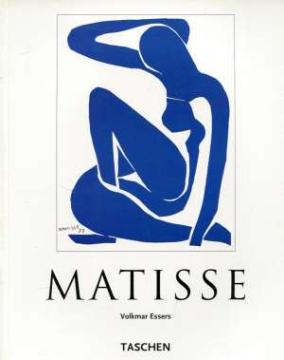
Velikani likovne umjetnosti #28: Henri Matisse - Majstor boje

Velikani likovne umjetnosti #28: Henri Matisse - Majstor boje

Volkmar Essers

Each book in Taschen's Basic Art series contains a detailed chronological summary of the artist's life and work, covering the artist's cultural and historical significance, approximately 100 color illustrations with explanations, and a brief biography.

Henri Matisse developed in the atmosphere of Neo-Impressionism, especially P. Signac, and the influence of P. Cézanne, P. Gauguin and V. van Gogh, and his painting was identical to that of the group of French Fauvist artists with whom he exhibited at the Salon des Indépendants in 1905. Matisse reduced each motif to its essential, precisely symbolic form, seemingly imposed, but in fact subtly simplified by a capricious arabesque line. He applied color in pure and airy tonalities in full chords of an open palette and rhythmically harmonized patterns. His frequent motifs are nudes or semi-nudes, odalisques in interiors with exotically ornamented draperies and carpets. Living mainly in southern France, he painted landscapes from Saint-Tropez and the area around Nice (Montalban, 1918). In the latter period of his life, he switched to the collage technique; he cut out sinuous figures from multi-colored paper, similar to fantastic leaves, and glued them into bizarre ornamental combinations. As a convert, he produced his last work, the project and designs for the interior decoration and furnishings of the chapel of Our Lady of the Holy Rosary in the village of Vence near Nice (1943–48, completed 1951). He produced monochrome and multi-color graphics, which had purely painterly values, and small sculptures (Little Head, 1906–07; Seated Nude, 1925). He illustrated works by Ch. Baudelaire, S. Mallarmé and J. Joyce, made ceramics and designed products of applied art (tapestry, glass, stained glass), set design and costumes for S. P. Diaghilev's Ballets Russes (I. Stravinsky, The Nightingale's Song, 1920). The Matisse Museum is located in his birthplace.

Prevod
Westerna Comunicazione
Naslovnica
Catinka Keul, Angelika Taschen
Dimenzije
23 x 18,5 cm
Broj strana
96
Izdavač
Jutarnji list, Zagreb, 2007.
 
Latinica. Broširano.
Jezik: Hrvatski.
ISBN
978-9-53674-878-5

Više primeraka je u ponudi

Primerak broj 1

Stanje:Korišćeno, u odličnom stanju
Dodato u korpu!

Primerak broj 2

Stanje:Korišćeno, u odličnom stanju
Dodato u korpu!

Primerak broj 3

Stanje:Korišćeno, u odličnom stanju
Dodato u korpu!
 

Zanima Vas i neka druga knjiga? Možete pretražiti našu ponudu pomoću pretrage ili prelistati knjige po kategorijama.

Možda će Vas zanimati i ovi naslovi

Brera (brief guide)

Brera (brief guide)

Stefano Zuffi

Vodič kroz galerije

Electa, 2005.
Hrvatski. Latinica. Broširano.
7,98
Vodnik po zbirkah pokrajinskega muzeja Celje

Vodnik po zbirkah pokrajinskega muzeja Celje

Janez Cvirn, Vera Kolšek, Milena Moškon, Vladimir Šlibar, Tatjana Badovinac, Darja Pirkmajer
Pokrajinski muzej Celje, 1993.
Slovenački. Latinica. Broširano.
4,89
Galerije u Slavoniji

Galerije u Slavoniji

Zavod za unapređivanje osnovnog obrazovanja, 1971.
Hrvatski. Latinica. Broširano.
1,08
Zbirka Kokša: Pečat vjere, trag umjetnosti

Zbirka Kokša: Pečat vjere, trag umjetnosti

Danijela Markotić, Darija Alujević, Ana Biočić, Sanja Cvetnić, Vlado Mikšić

Tijekom svog života i rada biskup Kokša sustavno je prikupljao umjetnička djela brojnih domaćih i stranih majstora iz različitih umjetničkih razdoblja u rasponu od pet stoljeća (16. – 20. st).

Galerija Klovićevi dvori, 2022.
Hrvatski. Latinica. Broširano.
17,35
Crteži Osijeka (mapa br. 3)

Crteži Osijeka (mapa br. 3)

V. Kuti
Sigra, 1987.
Hrvatski. Latinica. Broširano.
9,88
Ivan Rein

Ivan Rein

Jelica Ambruš

U monografiji je rekonstruiran život i djelo Ivana Reina, znamenitog i prerano preminulog hrvatskog slikara židovskog podrijetla u vihorima drugog svjetskog rata.

Institut za povijest umjetnosti Sveučilišta u Zagrebu, 1993.
Hrvatski. Latinica. Tvrde korice s omotom.
18,6214,90