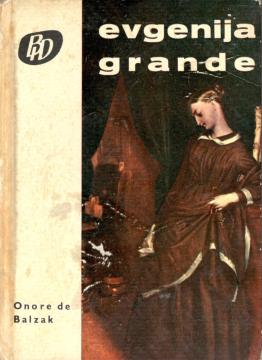
Evgenija Grande / Muzej starina

Evgenija Grande / Muzej starina

Honore de Balzac

In his novels Eugenie Grandet (1833) and The Museum of Antiquities (1837), Balzac explores universal themes of greed, human passions, sacrifice, and moral dilemmas, placing them in different social contexts of 19th-century French society.

  • Eugène Grande: A novel from The Human Comedy (1833) is set in Saumur, where the miserly Félix Grande, a wealthy merchant, controls his family – his wife and daughter Eugène. His obsession with money stifles all joy. Eugène, young and innocent, falls in love with her cousin Charles, a spoiled Parisian who arrives after her father's bankruptcy and suicide. She gives him her gold so that he can start a new life in India, waiting for him faithfully. Félix dies, leaving Eugène a fortune, but Charles betrays her, choosing a marriage of convenience. Heartbroken, Eugène marries Judge Cruchot, who soon dies. As a wealthy widow, she lives a solitary life, dedicated to charity. Balzac explores greed, sacrifice, and the tragic power of unrequited love.

  • "The Museum of Antiquities" (1837), part of Balzac's Human Comedy, is set in the provincial town of Alençon and Paris, where the fates of the aristocracy and the bourgeoisie intertwine. The story follows the young Victurnien d'Esgrignon, a nobleman from an old family, whose extravagance and gambling debts threaten the family's honor. His aunt, Armande, and father try to save him, but Victurnien falls into a web of manipulation by Chesnel, a loyal servant, and Du Croisier, a cunning bourgeois who wants to destroy d'Esgrignone. The plot is complicated when Victurnien steals money, and his love affair with a Parisian noblewoman further drags him into ruin. Balzac explores the conflict between the decadent aristocracy and the ambitious bourgeoisie, depicting moral corruption, social intrigue, and the decline of the old order. The novel is a satire of society and a character study, emphasizing the powerlessness of tradition in the face of the new capitalist world.

Titel des Originals
Eugenie Grandet / Le cabinet des antiques
Übersetzung
Dušan Đokić, Ilija Kecmanović
Editor
Milica Grabovac
Maße
16,5 x 12 cm
Seitenzahl
352
Verlag
Svjetlost, Sarajevo, 1963.
 
Latein Schrift. Hardcover.
Sprache: Kroatisch.

Angeboten wird ein Exemplar

Zustand:Gebraucht, in ausgezeichnetem Zustand
Nachteile/Unannehmlichkeiten:
  • Traces of patina
Zum Warenkorb hinzugefügt!
 

Interessieren Sie sich für ein anderes Buch? Sie können das Angebot über unsere Suchmaschine suchen und finden oder Bücher nach Kategorien durchsuchen.

Diese Titel könnten Sie auch interessieren

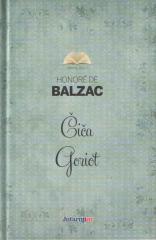
Čiča Goriot

Čiča Goriot

Honore de Balzac

Čiča Goriot je priča o starome ratnom profiteru Goriotu i njegovim kćerima, koje ga, nakon što su ga opljačkale do gole kože, ostavljaju da umre u samoći i bijedi pansiona Vaquer, priča je koja se danas može čitati na nekoliko razina.

Europapress holding, 2008.
Kroatisch. Latein Schrift. Hardcover.
6,32 - 6,99
Sjaj i bijeda kurtizana

Sjaj i bijeda kurtizana

Honore de Balzac

Sjaj i bijeda kurtizana dio je Balzacove zbirke Ljudska komedija. Roman prati sudbinu Luciena de Rubempréa, ambicioznog mladog pjesnika, i njegov odnos s tajnovitim Vautrinom, bivšim robijašem, u svijetu pariške dekadencije, intriga i morala.

Globus, 2004.
Kroatisch. Latein Schrift. Hardcover.
4,76 - 4,82
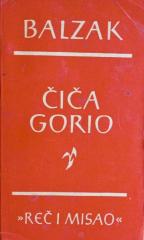
Čiča Gorio

Čiča Gorio

Honore de Balzac

Uncle Goriot is the story of the old war profiteer Goriot and his daughters, who, after robbing him to the point of being naked, leave him to die in the solitude and misery of the Vaquer boarding house. It is a story that can be read today on several leve

Rad, 1961.
Serbisch. Latein Schrift. Taschenbuch.
1,99
Studengrad

Studengrad

Dragan Lakićević
Znanje, 1985.
Kroatisch. Latein Schrift. Taschenbuch.
3,62
Crvendać

Crvendać

Jo Nesbo

The Redstart is the third novel in the Harry Hole series by Jo Nesbø. The story takes place in two time periods, interweaving the events of World War II with modern crimes in Norway.

Fokus komunikacije d.o.o., 2017.
Kroatisch. Latein Schrift. Taschenbuch.
6,58 - 9,36
Šljunak

Šljunak

Barbara König
Zora, 1965.
Kroatisch. Latein Schrift. Fester Einband mit Schutzumschlag.
4,99