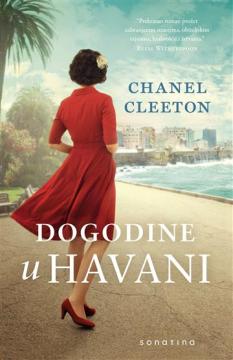
Dogodine u Havani

Dogodine u Havani

Chanel Cleeton

Chanel Cleeton, an American writer of Cuban descent, intertwines two love stories of a related family in the novel, evoking the spirit of Cuba through revolution and exile. The plot takes place in two time periods: 1958-1959 and the present.

In the past, Elisa Perez, the 19-year-old heiress of a wealthy sugar dynasty, lives in the luxury of Havana's high society under the Batista dictatorship. While the men of the Perez family influence politics, the sisters enjoy dancing, cocktails and romantic adventures. Elisa meets the rebellious Son of Rebellion, the charismatic Pablo, and falls in love with him in the midst of the revolutionary whirlwind. Their forbidden love, full of secret meetings and danger, symbolizes the conflict between the old Cuba and the coming communism. When Batista falls, the Perezs flee to Miami, leaving Elisa with a broken heart and a secret – Pablo has been executed by revolutionaries, and she is carrying his child.

In the present, after the death of Elisa (who died as Marisol's grandmother), 30-year-old journalist Marisol Ferrer comes to Havana to fulfill a promise: to scatter the ashes and investigate the roots. As a Cuban-American, Marisol uncovers family secrets, encounters discreet dissidents, and meets Louis, a local guide and activist whose passion for change awakens her own. As she explores the past—from old photographs and letters to memories of the revolution—Marisol grapples with exile’s grief, identity, and hope for Cuba’s future.

Inspired by her family’s story, Cleeton masterfully weaves history (the fall of Batista, the Casusa, the exodus) with intimate emotion, critiquing political repression and celebrating the Cuban soul—the rhythm of salsa, the smell of tobacco, the warmth of family. A New York Times bestseller and Reese Witherspoon Book Club selection, the novel is a reminder of the fragility of freedom and the power of love to overcome time.

Original title
Next Year in Havana
Translation
Jelena Pitaki
Editor
Silvia Sinković
Dimensions
21.5 x 14 cm
Pages
366
Publisher
Sonatina, Zagreb, 2019.
 
Latin alphabet. Paperback.
Language: Croatian.
ISBN
978-9-53486-011-3

One copy is available

Condition:Used, excellent condition
 

Are you interested in another book? You can search the offer using our search engine or browse books by category.

You may also be interested in these titles

Rođaka Beta

Rođaka Beta

Honore de Balzac
Svjetlost, 1970.
Croatian. Latin alphabet. Hardcover.
5.00
Koliba

Koliba

William P. Young

U kolibi Vilijama P. Janga, Makenzi Filips, ožalošćeni otac koji se bori sa gubitkom svoje najmlađe ćerke, dobija misterioznu poruku koja ga poziva u napuštenu kolibu gde je njegova ćerka ubijena.

Naklada Ljevak, 2010.
Croatian. Latin alphabet. Paperback.
7.36
I ne reče ni reči

I ne reče ni reči

Heinrich Böll

In Boll's novels, one of the central themes is the attempt to preserve basic moral values ​​in a time of terror, as well as in a period of material prosperity and corruption.

Svjetlost, 1965.
Serbian. Latin alphabet. Paperback.
3.22 - 3.98
Neisplakani

Neisplakani

Mirko Božić

The novel "Neisplakani" explores the themes of real life, relationships and conflicts between different social strata, and deeper human emotions and experiences.

Zora, 1955.
Croatian. Latin alphabet. Hardcover.
7.98
Dok ležah na samrti

Dok ležah na samrti

William Faulkner

Faulkner's 1930 novel, a classic example of modernist literature. It is often compared to Joyce's "Ulysses" for its innovative structure, but is more accessible due to its focus on family.

Rad, 1985.
Croatian. Latin alphabet. Paperback.
3.26
Tko se boji lika još : priprema ispita iz nove hrvatske proze

Tko se boji lika još : priprema ispita iz nove hrvatske proze

Julijana Matanović

Since the first book, the theme of literature has been a constant feature of Julijana Matanović's prose. The author's "reckoning" with previous analyses, as well as with the list of selected reading titles, is clearest precisely in the texts included in t

Profil Knjiga, 2008.
Croatian. Latin alphabet. Paperback.
9.72 - 9.76