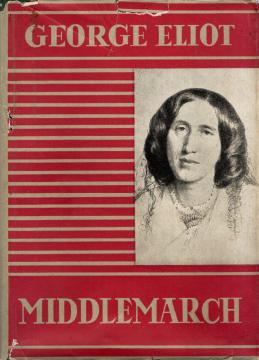
Middlemarch I: Gospođica Brooke

Middlemarch I: Gospođica Brooke

George Eliot

In the first book of the novel, we meet Dorothea Brooke, a 19-year-old girl who wants a great life dedicated to good. She marries the old scholar Casaubon, thinking that he will help her in her intellectual work, but the marriage brings disappointment.

Middlemarch George Eliot (pseudonym of Mary Ann Evans) begins with Prelude and Book I: Miss Brooke, which were originally separate stories before being combined into a larger novel. The Prelude compares Dorothea to unrealized female ideals such as St. Teresa of Avila—a woman of spiritual greatness but limited by circumstances in provincial England 1829–1832 (before the Reform Act of 1832).

The main character Dorothea Brooke, a 19-year-old orphan, lives with her younger sister Celia at her uncle Mr. Brooke's Tipton Grange. Dorothea is intelligent, religious, and ascetic—she wears simple clothes, rejects luxury, and dreams of great deeds for the betterment of the world. She idealizes knowledge and spirituality, and despises trivialities. Celia is her opposite—practical, conventional, "common sense."

Uncle Brooke, an indecisive liberal, brings guests: Sir James Chettam, a young, wealthy baron who woos Dorothea (she rejects him because she finds him too "plain"), and Reverend Edward Casaubon, a 45-year-old scholar working on The Key to All Mythologies. Dorothea sees in him an intellectual giant – a father figure who will introduce her to deep knowledge and give her purpose. He ignores warnings (Celia, Mrs. Cadwallader, uncle) that Casaubon is dry, old, passionless. She marries him, hoping that he will help him in his work and live a "big life".

Casaubon is actually meticulous, insecure, afraid that Dorothea is too young and attractive for him. He introduces her to Lowick Manor, where she meets his cousin Will Ladislaw (young, artistic, liberal) – which leads to the first tensions. Dorothea realizes that Casaubon is not the genius she imagined him to be—his work is sterile, and he does not allow her to realize herself.

Book I introduces key themes: idealism versus reality, the limitations of women in Victorian society, marriage as a trap for ambitious souls, provincial life full of hypocrisy and petty ambition. Eliot writes realistically, with irony and deep psychological analysis—Dorothea is sympathetic, but also blinded by self-deception. This is the introduction to a larger novel that will expand to include Lydgate, the Vincys, Bulstrode, and political change.

Naslov originala
Middlemarch: A Study of Provincial Life, Book I: Miss Brooke
Prevod
Otilija Šnajder-Ruškovski, Franjo Hartl
Dimenzije
19 x 13 cm
Broj strana
240
Izdavač
Matica hrvatska, Zagreb, 1961.
 
Latinica. Tvrde korice s omotom.
Jezik: Hrvatski.

Jedan primerak je u ponudi

Stanje:Korišćeno, u dobrom stanju (tragovi korišćenja)
Oštećenja / nepogodnosti:
  • The cover is missing
  • Worn covers
Dodato u korpu!
 

Zanima Vas i neka druga knjiga? Možete pretražiti našu ponudu pomoću pretrage ili prelistati knjige po kategorijama.

Možda će Vas zanimati i ovi naslovi

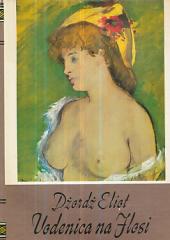
Vodenica na Flosi

Vodenica na Flosi

George Eliot

The plot revolves around young man Tom, ambitious in his educational plans, and girl Maggie, who likes to dream.

Minerva, 1984.
Srpski. Latinica. Tvrde korice s omotom.
4,86 - 5,28
Drugovi I-II

Drugovi I-II

Tone Seliškar

A collection of short stories that follow the lives of young people, mostly pupils and students, during and after World War II, with an emphasis on their ideological struggle, maturation, and development of awareness of social changes.

Veselin Masleša, 1962.
Hrvatski. Latinica. Tvrde korice.
Knjiga se sastoji od dva toma
6,32
Kronika o siromašnim ljubavnicima

Kronika o siromašnim ljubavnicima

Vasco Pratolini

Florenz 1925–1926: In der armen Via del Corno leben die Bewohner in Liebe, Armut und Angst. Die Ankunft des Faschismus zerstört die Gemeinschaft: Liebende streiten, manche sterben durch Gewalt, doch der Zusammenhalt der Bevölkerung bleibt bestehen.

Sveučilišna naklada Liber (SNL), 1982.
Hrvatski. Latinica. Tvrde korice s omotom.
3,76
Blato

Blato

Milana Vlaović

Miana Vlaović's debut novel is a story about three generations of women in a patriarchal province, filled with recurring patterns of fate - love, betrayal, poverty, violence, and small struggles for dignity.

V.B.Z, 2007.
Hrvatski. Latinica. Broširano.
6,38
Rimske priče: izbor

Rimske priče: izbor

Alberto Moravia

Collections of short stories from Roman life in the post-war era: ordinary people from the people and the petty bourgeoisie – the poor, workers, small craftsmen – face misery, survival, jealousy, petty deceit and moral compromises in everyday life.

Otokar Keršovani, 1966.
Hrvatski. Latinica. Tvrde korice.
3,98
I ne reče ni reči

I ne reče ni reči

Heinrich Böll

In Boll's novels, one of the central themes is the attempt to preserve basic moral values ​​in a time of terror, as well as in a period of material prosperity and corruption.

Svjetlost, 1965.
Srpski. Latinica. Broširano.
3,22 - 3,98