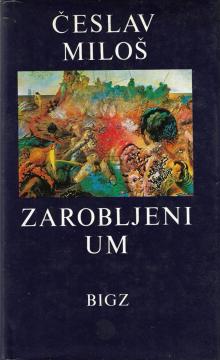
Zarobljeni um

Zarobljeni um

Czesław Miłosz

The Captive Mind is a book published in France in 1953 by Czesław Miłosz, shortly after he was granted political asylum in Paris due to his conflict with the communist authorities in Poland, which was then under the control of the USSR.

"The anti-communists considered my book suspicious because I did not attack the communists strongly enough. I tried to understand the process and they did not like it. And it also created the idea, especially in the West, that I was a political writer. This was a confusion because my poetry was unknown. I was never a political writer and I tried very hard to destroy that idea of ​​myself." - Czesław Miłosz

The book is written in stream-of-consciousness form and tells of the author's experiences while living in underground circles in Poland during World War II, his position and the status of other Polish intellectuals in the post-war years, as well as his reflections on the temptation of collaboration with the Stalinist regime among intellectuals in Eastern Europe. Miłosz states that he wrote the book "in the midst of a great internal conflict".

The book begins with a discussion of the novel Nienasycenie by Stanisław Ignacy Witkiewicz, which mentions the Murti-Bing pill, which, when swallowed, leads to a voluntary change of mind and political control, and is therefore suitable for the acceptance of the Soviet version of communism among the population, but theoretically also American capitalism. In the second chapter, the author discusses how Poland and Eastern Europe look to the West, while the third discusses a clever trick of deception known as Ketman, in which an individual pretends to accept a government's worldview and even publicly and loudly propagates it, but in reality harbors a deep contempt for it and, knowing that it is wrong, knows that the faster it spreads among the population, the sooner it will collapse.

From the fourth chapter onwards, Miłosz then describes how his Polish people suffered during the fascist occupation of the country in World War II, as well as how they suffered when the resistance movement rose up against the Nazis in 1944 when the Red Army was at the gates of Warsaw, expecting them to join them in the fight. However, the Red Army stopped and allowed the Nazis to massacre large numbers of Poles, in order to eliminate all traces of the old, pre-war Polish government and thus make it easier to establish a new, pro-Soviet Polish government. Miłosz also talks about his acquaintances who, disappointed and reluctant, accepted to serve the new post-war Soviet authorities, whom he called Alpha, Beta - a gifted writer who wasted his talent on writing political tracts because he believed that the Soviet regime, no matter how bad, would still ensure that a new Auschwitz would not happen again - Gamma and Delta - who obeyed by writing according to the strictly dictated socialist realism. According to some opinions, these personalities were Jerzy Andrzejewski, Tadeusz Borowski, Jerzy Putrament and Konstanty Ildefons Gałczyński.

Miłosz ends his writing with the Soviet annexation of the Baltic states, in which he wonders how the various Baltic peoples lost all trace of their homeland and nation when they were displaced far to Asia to work in collective farms, and with his own experience when before the war he was on a trip through the USSR and at a train station in the middle of a crowd he noticed a Polish family who gave a child a warm drink in the winter, for which he could not hold back a tear in his eye because he subconsciously interpreted it as the only an oasis of humanity and warmth in that society.

Titel des Originals
Zniewolony umysł
Übersetzung
Petar Vujičić
Editor
Jovan Radulović
Illustrationen
Salvador Dali
Titelseite
Rade Rančić
Maße
21 x 13 cm
Seitenzahl
336
Verlag
BIGZ, Beograd, 1987.
 
Auflage: 10.000 Exemplare
 
Latein Schrift. Fester Einband mit Schutzumschlag.
Sprache: Serbisch.
ISBN
8-61-300113-0

Es werden zwei Exemplare angeboten
Kopiennummer 1

Zustand:Gebraucht, in ausgezeichnetem Zustand
Zum Warenkorb hinzugefügt!

Kopiennummer 2

Zustand:Gebraucht, in sehr gutem Zustand
Nachteile/Unannehmlichkeiten:
  • Library stamp
  • Underlined in pencil
Zum Warenkorb hinzugefügt!
 

Interessieren Sie sich für ein anderes Buch? Sie können das Angebot über unsere Suchmaschine suchen und finden oder Bücher nach Kategorien durchsuchen.

Diese Titel könnten Sie auch interessieren

Zemlja Ulro

Zemlja Ulro

Czesław Miłosz
Dečje novine, 1982.
Serbisch. Latein Schrift. Taschenbuch.
7,985,59
Snoviđenja nad zalivom San Francisko

Snoviđenja nad zalivom San Francisko

Czesław Miłosz
Dečje novine, 1982.
Serbisch. Latein Schrift. Taschenbuch.
4,36
Sam protiv njih

Sam protiv njih

Roman Leljak

A non-fiction work by a Slovenian investigator of the UDB archives. The author, a former KOS employee, left the army after learning about the crimes of the Yugoslav army during the war and the post-war period, and dedicated himself to exposing the secret

Vlastita naklada, 1990.
Kroatisch. Latein Schrift. Taschenbuch.
16,42
Izabrani radovi

Izabrani radovi

Ljubo Boban

Selected Works of Academician Ljubo Boban (2022) brings together key texts on contemporary Croatian history of the 20th century. The foreword by Damir Agičić highlights Boban's methodological rigor and objectivity in researching sensitive topics.

Srednja Europa, 2022.
Kroatisch. Latein Schrift. Hardcover.
24,52
Historijat novih ljevica u Europi (1956-1978)

Historijat novih ljevica u Europi (1956-1978)

Massimo Teodori
Globus, 1979.
Kroatisch. Latein Schrift. Fester Einband mit Schutzumschlag.
8,54
Dan prije svanuća

Dan prije svanuća

Thomas Wiseman

A historical novel based on true events from the closing days of World War II. The story follows a special Reich investigator, Ernst Schöller, who possesses extensive knowledge of key figures and secrets of the Third Reich.

August Cesarec, 1979.
Kroatisch. Latein Schrift. Fester Einband mit Schutzumschlag.
7,345,51