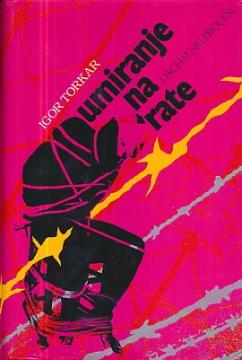
Umiranje na rate: Dachauski procesi

Umiranje na rate: Dachauski procesi

Igor Torkar, Boris Fakin

A novel by Igor Torkar (Boris Fakin) dealing with "Dachau processes". Through a mixture of documentary and fiction, Torkar exposes the taboo subject of the communist regime, basing the story on his own experience as a prisoner in Dachau and Goli otok.

The main character, Martin Pevkar, faces the injustice of trials in which former internees, mostly communists and Spanish fighters, are accused of collaboration because they survived the camps. The novel follows Pevkar's life after liberation, his struggle with trauma, moral dilemmas, and a sense of betrayal by the system he fought for. Through a non-linear narrative and shifting perspectives, Torkar depicts the psychological consequences of repression, the corruption of government, and the loss of humanity. Pevkar struggles with inner demons as he recalls the horrors of the camps, the trials, and social ostracism.

Torkar bases the story on his own experiences as a prisoner in Dachau and Goli Otok. Documentary elements, such as Torkar's testimony, enhance the authenticity, while the satirical tone exposes the absurdities of the regime. The novel is politically courageous, has caused a strong resonance, and is considered a key work on communist repression. It has been translated into Croatian and German, and the third edition (1996) includes additional documents about the trials.

Translation
Mirjana Hećimović
Editor
Ivana Sor
Illustrations
Vlasto Kopač, Stane Kumar, France Mihelič
Graphics design
Bronislav Fajon
Dimensions
20.5 x 14 cm
Pages
428
Publisher
Globus, Zagreb, 1984.
 
Latin alphabet. Hardcover with dust jacket.
Language: Croatian.

Two copies are available

Copy number 1

Condition:Used, excellent condition

Copy number 2

Condition:Used, very good condition
Damages or inconvenience notice:
  • Traces of patina
  • The cover is missing
 

Are you interested in another book? You can search the offer using our search engine or browse books by category.

You may also be interested in these titles

Povratak

Povratak

Erich Maria Remarque
Minerva, 1955.
Croatian. Latin alphabet. Hardcover.
1.62 - 2.36
Zbogom oružje

Zbogom oružje

Ernest Hemingway

Hemingway's novel A Farewell to Arms (1929), set on the Italo-Austrian front, follows the love story and wartime experiences of Frederic Henry, an American lieutenant who serves as an ambulance driver in the Italian army during World War I.

Mladost, 1952.
Croatian. Latin alphabet. Paperback.
1.00 - 6.50
Grešna nedelja

Grešna nedelja

Tome Momirovski

The work combines elements of drama, eroticism, and social criticism, set in a summer that the main characters will remember forever.

Kosmos, 1963.
Serbian. Latin alphabet. Hardcover with dust jacket.
3.98
Kad su cvetale tikve

Kad su cvetale tikve

Dragoslav Mihailović

When Dragoslav Mihailović's Pumpkins Bloomed is the story of the Belgrade (Dušanova) boxer Ljubi Šampion (also known as "Ljuba Vrapče"): at the same time, a novel about emigration, nostalgia, a political novel, a book about growing up and urbanity, about

BIGZ, 1989.
Serbian. Latin alphabet. Paperback.
7.32
Nesreća nevinih

Nesreća nevinih

Agatha Christie

One of Christie's darkest and most emotional novels. "The misfortune of the innocent is worse than the guilt of the guilty." According to Agatha Christie herself, this is, along with The Haunted House, the best novel she has ever written.

Globus, 1984.
Croatian. Latin alphabet. Hardcover with dust jacket.
7.56
Krimskrams

Krimskrams

Zoran Pilić

A black comedy about three friends in a midlife crisis. They are childish, egocentric, vain, irresponsible, and get into a series of tragicomic situations, and the novel features a whole gallery of characters from Zagreb's social life, as well as from the

Profil International, 2009.
Croatian. Latin alphabet. Paperback.
7.46