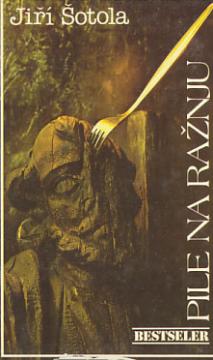
Pile na ražnju

Pile na ražnju

Jiří Šotola

Jiří Šotola's quasi-historical novel Pile on a Spit depicts the absurdity of life through the story of the antihero – the puppeteer Matija Pile (Matěj Kuře), a puppeteer of history during the Napoleonic Wars. The novel criticizes totalitarianism through b

In the maelstrom of the Napoleonic Wars, the forty-year-old peasant Matija Pila deserts the Battle of Marengo in 1800, flees to Carinthia and joins the acrobats, seeking freedom in jumping. He is haunted by the memory of La Tournesse's love; under the false name Luigi Sevastiano he seeks refuge in the castle of Count Waldstein near Litomyšl, but fails in the Don Juan exercises – his trousers fall off – and flees to the Piarists with Father Prospero. There he talks to spirits, God and dolls who whisper about his broken soul, steals them and continues to wander as an eternal slave of chaos.

He returns home: his brother Lukaš, a greedy drunkard who abuses his stepdaughter Barbara, suspects him of the inheritance. Matija becomes attached to her, takes her away from violence with him and the dolls. They travel and earn money by performing, but Barbara dies in childbirth, leaving him a son. Matija becomes a vagabond, the dolls come to life, revealing the depths of the mind; obtains a false passport (Ondřej Serenus), but is recalled to the army for Slavkov 1805 – The French kill the puppets, mixing worlds. He dies in straw, surrounded by ghosts, with a longing for freedom in small moments.

Matija is an antihero, a victim of the vortex that breaks man against great powers (Napoleon as the framework of totalitarianism). Šotola celebrates escape into the inner world: conversations mock faith and celebrate strength in self-confidence. The story mixes the sublime and the crude, the real and the imaginative in a circular story of 33 chapters, full of irony. Like Kafka and Hrabal, Šotola warns against the deceptions of authority and power.

Titel des Originals
Kuře na rožni
Übersetzung
Dagmar Ruljančić
Editor
Dragan Milković
Titelseite
Nenad Dogan
Maße
19,5 x 12 cm
Seitenzahl
279
Verlag
August Cesarec, Zagreb, 1983.
 
Latein Schrift. Fester Einband mit Schutzumschlag.
Sprache: Kroatisch.

Es werden zwei Exemplare angeboten

Kopiennummer 1

Zustand:Gebraucht, in ausgezeichnetem Zustand
Zum Warenkorb hinzugefügt!

Kopiennummer 2

Zustand:Gebraucht, in ausgezeichnetem Zustand
Nachteile/Unannehmlichkeiten:
  • Traces of patina
Zum Warenkorb hinzugefügt!
 

Interessieren Sie sich für ein anderes Buch? Sie können das Angebot über unsere Suchmaschine suchen und finden oder Bücher nach Kategorien durchsuchen.

Diese Titel könnten Sie auch interessieren

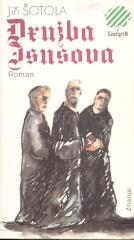
Družba Isusova

Družba Isusova

Jiří Šotola

„Družba Isusova“ (1969) Jiržija Šotole, debitantsko delo češkog pesnika, je istorijski roman smešten u vreme kontrareformacije, koji suptilno aludira na savremene uslove u Čehoslovačkoj pod komunizmom.

Znanje, 1988.
Kroatisch. Latein Schrift. Taschenbuch.
4,00 - 4,20
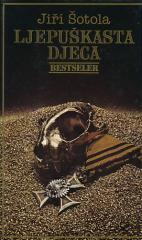
Ljepuškasta djeca

Ljepuškasta djeca

Jiří Šotola

Roman „Lepuškasta deca“ prikazuje svet adolescentnih pobunjenika u „prevaspitnoj“ koloniji – zatvoru prerušenom u školu. Napisano u duhu Praškog proleća, delo kritikuje komunistički sistem kroz dinamičnu, filmsku naraciju.

August Cesarec, 1986.
Kroatisch. Latein Schrift. Fester Einband mit Schutzumschlag.
4,82 - 4,84
Družba Isusova

Družba Isusova

Jiří Šotola

Družba Isusova je prvi put objavljena 1969. godine i ubrzo je privukla pažnju kritičara i publike širom sveta. Iako je reč o istorijskom romanu, ima poređenja sa savremenim prilikama i događajima u zavičaju autora.

Znanje, 1975.
Kroatisch. Latein Schrift. Fester Einband mit Schutzumschlag.
2,98 - 4,26
Andrićeva lestvica užasa

Andrićeva lestvica užasa

Svetislav Basara

Srpski pisac poznat po satiričnim romanima, u Andrićevoj lestvici užasa secira balkanski mentalitet kroz parabolu jugonostalgije i nacionalnih mitova. Naziv aludira na Ivu Andrića kao lakmus-papir za kritiku – Balkanci ga svojataju ili odbacuju po volji.

24 sata, 2021.
Serbisch. Latein Schrift. Taschenbuch.
11,56
Crna kutija

Crna kutija

Amos Oz

Crna kutija je kaleidoskop bračnog života i ljubavnih veza. To je roman koji implicitno govori o svima nama.

Hena Com, 2001.
Kroatisch. Latein Schrift. Hardcover.
10,98
Kad žena zri

Kad žena zri

Honore de Balzac
Svjetlost, 1970.
Kroatisch. Latein Schrift. Hardcover.
4,99 - 5,00