Zlatno tele
Ein rares Buch

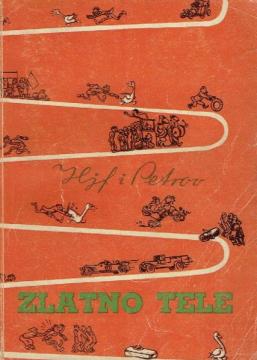
Zlatno tele

Ilja Iljf, Jevgenij Petrov

The Golden Calf (1931) is a brilliant satirical picaresque adventure, a sequel to the legendary 12 Chairs, where the great schemer Ostap Bender returns in full glory – charming, cynical, irredeemably cunning and always one step ahead of everyone else.

The story takes place in the Soviet Union in the late 1920s, during the NEP and the beginning of the five-year plan, when old Russia was mixing with new socialist dreams. Ostap Bender, who survived in the first novel (although he did not receive millions), now sets his sights on a new target: the secret treasury of businessman Alexander Koreiko, one of the rare Soviet millionaires who made his fortune through smuggling, bribery and manipulation, and lives modestly as an ordinary accountant. Bender gathers a team of "lieutenant's sons" - a motley crew of swindlers, dreamers and opportunists - and sets off on a grand chase across the entire USSR: from Moscow, through Kharkov, over the railways, to the Black Sea and Central Asia.

The novel is full of hilarious episodes: fake film footage, the "Antelope-Gnu" car that becomes a legend, encounters with bureaucrats, journalists, the police and ordinary people. Bender excels with his aphorisms ("Don't bother, I'll tell you the truth - I'm a great schemer!", "The rich are poor people"), ridiculing the corruption, bureaucracy, greed and hypocrisy of the new society. But beneath the humor lies a bitter note: Ostap is a tragic character - a brilliant swindler who dreams of "Rio de Janeiro" (a symbol of freedom and wealth), but realizes that there is no place for an individual like him in the Soviet Union.

Ilf and Petrov write quickly, humorously, with Odessa charm and a keen eye for the absurd - the novel is full of quotations that have entered the language ("How is life on the Riva?", "Your telegram received, but not understood"). It is a satire on Soviet reality, but also a universal comedy about human greed and illusions.

Titel des Originals
Золотой телёнок
Übersetzung
Stjepan Kranjčević
Maße
20 x 14 cm
Seitenzahl
355
Verlag
Kultura, Zagreb, 1946.
 
Latein Schrift. Fester Einband mit Schutzumschlag.
Sprache: Kroatisch.

Angeboten wird ein Exemplar

Zustand:Gebraucht, in sehr gutem Zustand
Nachteile/Unannehmlichkeiten:
  • The cover is missing
Zum Warenkorb hinzugefügt!
 

Interessieren Sie sich für ein anderes Buch? Sie können das Angebot über unsere Suchmaschine suchen und finden oder Bücher nach Kategorien durchsuchen.

Diese Titel könnten Sie auch interessieren

Nova Šeherezada

Nova Šeherezada

Ilja Iljf, Jevgenij Petrov
Grafički zavod Hrvatske (GZH), 1964.
Serbisch. Latein Schrift. Hardcover.
4,99 - 5,47
Kako se stvarao Robinson

Kako se stvarao Robinson

Ilja Iljf, Jevgenij Petrov
Grafički zavod Hrvatske (GZH), 1964.
Serbisch. Latein Schrift. Hardcover.
4,953,98 - 4,974,95
Jednokatna Amerika

Jednokatna Amerika

Ilja Iljf, Jevgenij Petrov

After the great success of The Twelve Chairs and The Golden Calf, Ilyich and Petrov traveled the United States during the Great Depression and translated their observations into the novel One-Story America, continuing to write in a satirical style.

Naklada Binoza, 1939.
Kroatisch. Latein Schrift. Fester Einband mit Schutzumschlag.
11,32
Sabrana djela A. P. Čehova #7: Seljaci i druge novele

Sabrana djela A. P. Čehova #7: Seljaci i druge novele

Anton Pavlovič Čehov

Between 1892, when "The Fragment", the first novella in this book, was published, and "The Peasant" (1897) and "On the Carts" (1897), A. P. Chekhov made a series of other artistically successful observations of the society in which he lived.

Zora, 1960.
Kroatisch. Latein Schrift. Fester Einband mit Schutzumschlag.
13,62
Sabrana djela A. P. Čehova #5: Kaštanka i druge novele

Sabrana djela A. P. Čehova #5: Kaštanka i druge novele

Anton Pavlovič Čehov

The fifth book in a row of works by this great classic of Russian humor contains mainly his literary work from 1887. In this volume, the reader will find a number of already celebrated and well-known, as well as a large number of previously unpublished no

Zora, 1959.
Kroatisch. Latein Schrift. Fester Einband mit Schutzumschlag.
9,84
Ana Karenjina

Ana Karenjina

Lav Nikolajevič Tolstoj

"Anna Karenina" (1875–1877) is Leo Tolstoy's largest and most complex novel, often considered one of the greatest novels in world literature, praised for the depth of its characters and philosophical questions.

Mladost, 1952.
Kroatisch. Latein Schrift. Taschenbuch.
Das Buch besteht aus zwei Bänden
10,36