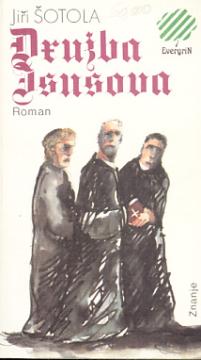
Družba Isusova

Družba Isusova

Jiří Šotola

The Society of Jesus (1969) by Jiří Šotola, the debut work of the Czech poet, is a historical novel set during the Counter-Reformation, which subtly alludes to contemporary conditions in Czechoslovakia under communism.

The plot follows Father Vojtěch Had and Countess Maria Maximiliana, whose fates intertwine in the conflict between the individual and the powerful Catholic Jesuit order. The novel explores themes of obedience, ideological oppression, and the loss of spiritual and human freedom. Vojtěch Had, a Jesuit priest, is faced with an internal conflict between his conscience and the strict rules of the order, where obedience is the highest value. Countess Maria Maximiliana, passionate and rebellious, comes into conflict with the church hierarchy, which leads to her spiritual and physical downfall. Their paths lead to a tragic end, where ideology suffocates humanity, leaving them as "empty physical shells". The novel is dark, with a heavy atmosphere, but also a layered narrative and dialogues that emphasize moral dilemmas. Šotola masterfully uses historical context to criticize totalitarian systems, making the novel universal. Croatian critic Ljudevit Bauer compared it to the novel Dervish and the Death of Meša Selimović due to similar themes of the conflict between the individual and the system. Published in 1975 in Croatia, the novel received critical acclaim and was adapted into a film in 2004, directed by Silvij Petranović.

Übersetzung
Nikola Kršić
Maße
20 x 12 cm
Verlag
Znanje, Zagreb, 1988.
 
Latein Schrift. Taschenbuch.
Sprache: Kroatisch.

Es werden zwei Exemplare angeboten

Kopiennummer 1

Zustand:Gebraucht, in ausgezeichnetem Zustand
Zum Warenkorb hinzugefügt!

Kopiennummer 2

Zustand:Gebraucht, in sehr gutem Zustand
Nachteile/Unannehmlichkeiten:
  • Eine Nachricht persönlicher Natur

Zum Warenkorb hinzugefügt!
 

Interessieren Sie sich für ein anderes Buch? Sie können das Angebot über unsere Suchmaschine suchen und finden oder Bücher nach Kategorien durchsuchen.

Diese Titel könnten Sie auch interessieren

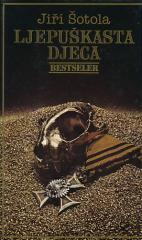
Ljepuškasta djeca

Ljepuškasta djeca

Jiří Šotola

The novel Beautiful Children depicts the world of adolescent rebels in a "re-education" colony - a prison disguised as a school. Written in the spirit of the Prague Spring, the work criticizes the communist system through a dynamic, cinematic narrative.

August Cesarec, 1986.
Kroatisch. Latein Schrift. Fester Einband mit Schutzumschlag.
4,82 - 4,84
Družba Isusova

Družba Isusova

Jiří Šotola

The Society of Jesus (1969) by Jiří Šotola, the debut work of the Czech poet, is a historical novel set during the Counter-Reformation, which subtly alludes to contemporary conditions in Czechoslovakia under communism.

Znanje, 1975.
Kroatisch. Latein Schrift. Fester Einband mit Schutzumschlag.
2,98 - 4,26
Krčma

Krčma

Julian Stryjkowski

Knjiga Julijana Strijkovskog „Svratište“, objavljena 1977. godine, istražuje život u malom jevrejskom selu u Galiciji tokom 19. veka.

BIGZ, 1977.
Serbisch. Latein Schrift. Taschenbuch.
4,38
Deobe

Deobe

Dobrica Ćosić

Deobe is a novel about the tragic division of Serbs into Chetniks and Partisans during World War II. Winner of the NIN Award, it is part of a wider epic trilogy, inspired by Ćosić's experiences and historical documents.

Prosveta, 1963.
Kroatisch. Latein Schrift. Fester Einband mit Schutzumschlag.
13,74
Zagrepčanka

Zagrepčanka

Branislav Glumac

Branislav Glumac published a novel without periods or commas in 1974, as the relentless stream of thought of a young rebel. Published in socialist Yugoslavia, the work caused a scandal with its openness and became a classic about generational rebellion.

IROS, 1986.
Kroatisch. Latein Schrift. Hardcover.
8,24
Crna kutija

Crna kutija

Amos Oz

Crna kutija je kaleidoskop bračnog života i ljubavnih veza. To je roman koji implicitno govori o svima nama.

Hena Com, 2001.
Kroatisch. Latein Schrift. Hardcover.
10,98