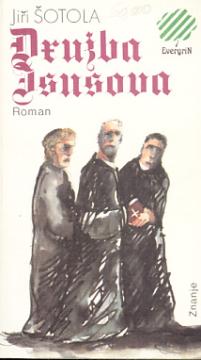
Družba Isusova

Družba Isusova

Jiří Šotola

The Society of Jesus (1969) by Jiří Šotola, the debut work of the Czech poet, is a historical novel set during the Counter-Reformation, which subtly alludes to contemporary conditions in Czechoslovakia under communism.

The plot follows Father Vojtěch Had and Countess Maria Maximiliana, whose fates intertwine in the conflict between the individual and the powerful Catholic Jesuit order. The novel explores themes of obedience, ideological oppression, and the loss of spiritual and human freedom. Vojtěch Had, a Jesuit priest, is faced with an internal conflict between his conscience and the strict rules of the order, where obedience is the highest value. Countess Maria Maximiliana, passionate and rebellious, comes into conflict with the church hierarchy, which leads to her spiritual and physical downfall. Their paths lead to a tragic end, where ideology suffocates humanity, leaving them as "empty physical shells". The novel is dark, with a heavy atmosphere, but also a layered narrative and dialogues that emphasize moral dilemmas. Šotola masterfully uses historical context to criticize totalitarian systems, making the novel universal. Croatian critic Ljudevit Bauer compared it to the novel Dervish and the Death of Meša Selimović due to similar themes of the conflict between the individual and the system. Published in 1975 in Croatia, the novel received critical acclaim and was adapted into a film in 2004, directed by Silvij Petranović.

Prevod
Nikola Kršić
Dimenzije
20 x 12 cm
Izdavač
Znanje, Zagreb, 1988.
 
Latinica. Broširano.
Jezik: Hrvatski.

Dva primerka su u ponudi

Primerak broj 1

Stanje:Korišćeno, u odličnom stanju
Dodato u korpu!

Primerak broj 2

Stanje:Korišćeno, u vrlo dobrom stanju
Oštećenja / nepogodnosti:
  • A message of a personal nature
Dodato u korpu!
 

Zanima Vas i neka druga knjiga? Možete pretražiti našu ponudu pomoću pretrage ili prelistati knjige po kategorijama.

Možda će Vas zanimati i ovi naslovi

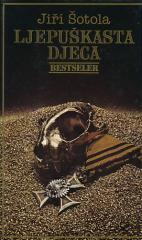
Ljepuškasta djeca

Ljepuškasta djeca

Jiří Šotola

The novel Beautiful Children depicts the world of adolescent rebels in a "re-education" colony - a prison disguised as a school. Written in the spirit of the Prague Spring, the work criticizes the communist system through a dynamic, cinematic narrative.

August Cesarec, 1986.
Hrvatski. Latinica. Tvrde korice s omotom.
4,82 - 4,84
Družba Isusova

Družba Isusova

Jiří Šotola

The Society of Jesus (1969) by Jiří Šotola, the debut work of the Czech poet, is a historical novel set during the Counter-Reformation, which subtly alludes to contemporary conditions in Czechoslovakia under communism.

Znanje, 1975.
Hrvatski. Latinica. Tvrde korice s omotom.
2,98
Zagrepčanka

Zagrepčanka

Branislav Glumac

Branislav Glumac published a novel without periods or commas in 1974, as the relentless stream of thought of a young rebel. Published in socialist Yugoslavia, the work caused a scandal with its openness and became a classic about generational rebellion.

IROS, 1986.
Hrvatski. Latinica. Tvrde korice.
8,24
V.

V.

Thomas Pynchon

The novel represents a journey into an alternative world – a world that we all belong to from time to time, but of which we would not want to be a part, a world of paranoia and alienation that we are not entirely sure is just an alternative or the bare tr

Čarobna knjiga, 2010.
Srpski. Latinica. Broširano.
21,98
Neprijatelji / ljubavna priča

Neprijatelji / ljubavna priča

Isaac Bashevis Singer

Enemies: A Love Story, perhaps Singer's best-known novel, takes place in New York in the 1950s.

Svjetlost, 1986.
Hrvatski. Latinica. Tvrde korice s omotom.
5,98
Rudnik čvaraka

Rudnik čvaraka

Tomislav Šovagović

The debut work of Croatian writer Tomislav Šovagović, awarded the Josip and Ivan Kozarac Award in 2012, is a dedication to Slavonia – the region of his childhood that the author, born in Dalmatia, observes with foreign but tender eyes.

Mozaik knjiga, 20112.
Hrvatski. Latinica. Broširano.
11,56