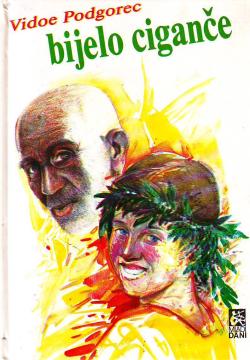
Bijelo ciganče

Bijelo ciganče

Vidoe Podgorec

The story of a boy named Tarun, who lost his parents during the war after they were killed by the Nazis. He was left by the side of the road, where he was found by wandering Roma who decided to adopt him. Because of his fair skin, they called him "White G

Tarun grows up in a Roma tent, accepting their way of life, customs and values. His adoptive father, Papa Mulon, was a man of a noble heart and became like a father to him. However, he is not accepted by all members of the community; Henza, Mulon's wife, shows hostility towards him, considering him a burden.

Despite the challenges, Tarun develops a strong bond with the horse Bresko, whom he raised after the death of his mare. Their friendship symbolizes Tarun's ability to find love and belonging in a world that often rejects him.

The novel explores themes of identity, belonging, tolerance and growing up. Through Tarun's story, the author shows how love and acceptance can overcome prejudice and hostility.

Translation
Borislav Pavlovski
Editor
Ljiljana Cikota
Graphics design
Milivoje Unković
Dimensions
19.5 x 14 cm
Pages
215
Publisher
Svjetlost, Sarajevo, 1989.
 
Distribution: 4,000 copies
 
Latin alphabet. Hardcover.
Language: Croatian.
ISBN
8-60-101442-9

One copy is available

Condition:Used, excellent condition
 

Are you interested in another book? You can search the offer using our search engine or browse books by category.

You may also be interested in these titles

Bijelo ciganče

Bijelo ciganče

Vidoe Podgorec

The story of a boy named Tarun, who lost his parents during the war after they were killed by the Nazis. He was left by the side of the road, where he was found by wandering Roma who decided to adopt him. Because of his fair skin, they called him "White G

Mladost, 1987.
Croatian. Latin alphabet. Paperback.
3.56 - 3.74
Luce sreće svog junaka

Luce sreće svog junaka

Ann Bryant
Grlica, 2002.
Croatian. Latin alphabet. Hardcover.
5.99
Užasi povijesti: Otkačeni Grci

Užasi povijesti: Otkačeni Grci

Terry Deary

The fourth book in the cult series The Horrors of History, and the style is typical of the series: history with "disgusting details" and "horrible facts" that teachers usually skip, presented in a humorous, sarcastic, and entertaining way for children 8+.

Egmont, 1996.
Croatian. Latin alphabet. Paperback.
8.36
Djetinjstvo

Djetinjstvo

Lav Nikolajevič Tolstoj

Childhood (1852) is the first book of an autobiographical trilogy (with Adolescence and Youth), where Tolstoy explores the world of childhood through the eyes of a ten-year-old boy, Nikolinka Irtenjev – innocence, joys, sorrows and first traumas.

Svjetlost, 1971.
Croatian. Latin alphabet. Hardcover.
6.54
Dupin Dirk i Lijena Kobila

Dupin Dirk i Lijena Kobila

Joža Horvat
Mozaik knjiga, 1997.
Croatian. Latin alphabet. Hardcover.
4.99
Kad vam roditelji prežive Holokaust

Kad vam roditelji prežive Holokaust

Bernice Eisenstein
Fraktura, 2010.
Croatian. Latin alphabet. Hardcover with dust jacket.
9.998.99