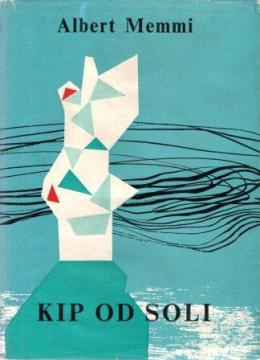
Kip od soli

Kip od soli

Albert Memmi

The Pillar of Salt (1953) is a semi-biographical novel that follows the life of a young Tunisian Jew between the two world wars. Set in colonial Tunisia, the novel explores themes of identity, alienation, and cultural conflict, reflecting Memmi's own expe

Mordecai, the son of a poor tailor, grows up in a Jewish neighborhood, where he faces prejudice from both the Muslim and Christian populations. His quest for education takes him from the local school to a French lycée, where he encounters colonial culture and begins to question his place in the world. He feels torn between his Jewish heritage, his Arab surroundings, and the Western ideals he aspires to. His intellectual ambition and sense of not belonging are further deepened when he goes to study philosophy in Paris.

The novel is deeply introspective, told in the first person, where Mordecai analyzes his inner conflicts and the trauma caused by discrimination and colonial hierarchy. His attempt to integrate into French society encounters obstacles, as he is not fully accepted there either. The title symbolizes Mordecai’s paralysis – like Lot’s wife, he is petrified in his inability to fully accept or abandon any of his identities.

Through a precise and poetic style, Memmi exposes the complexity of the colonial experience and the universal search for belonging. The novel ends without a final resolution, leaving Mordecai in limbo, which emphasizes the tragic nature of his struggle.

Original title
La Statue de sel
Translation
Srećko Džamonja
Graphics design
Zlatko Prica
Dimensions
30 x 14.5 cm
Pages
300
Publisher
Naprijed, Zagreb, 1965.
 
Latin alphabet. Hardcover with dust jacket.
Language: Croatian.

One copy is available

Condition:Used, very good condition
Damages or inconvenience notice:
  • The cover is missing
 

Are you interested in another book? You can search the offer using our search engine or browse books by category.

You may also be interested in these titles

Deobe 1-3

Deobe 1-3

Dobrica Ćosić

This work, awarded the NIN Prize for that year, is considered one of the most significant in Serbian literature after World War II.

Prosveta, 1961.
Serbian. Cyrillic alphabet. Hardcover with dust jacket.
The book consists of 3 volumes
11.42
Doba života, doba smrti / Slavoluk pobjede / Ljubi bližnjega svoga

Doba života, doba smrti / Slavoluk pobjede / Ljubi bližnjega svoga

Erich Maria Remarque

Selected works of Remarque in three volumes.

SKD Prosvjeta, 1963.
Croatian. Latin alphabet. Hardcover.
The book consists of 3 volumes
9.56
Amandino vjenčanje

Amandino vjenčanje

Jenny Colgan

A romantic comedy about friendship, love, and the chaotic attempts to save a good man from a bad marriage. A chick-lit hit, it reminds us that friendship saves more than any plan, and love comes unexpectedly.

Znanje, 2001.
Croatian. Latin alphabet. Paperback.
5.36
Andrićeva lestvica užasa

Andrićeva lestvica užasa

Svetislav Basara

A Serbian writer known for his satirical novels, Andrić's Ladder of Horrors dissects the Balkan mentality through a parable of Yugo-nostalgia and national myths. The title alludes to Ivo Andrić as a litmus test for criticism – Balkans claim him or reject

24 sata, 2021.
Serbian. Latin alphabet. Paperback.
11.56
Đavoli dolaze

Đavoli dolaze

Miodrag Bulatović
Rad, 1986.
Serbian. Latin alphabet. Paperback.
1.16
Klatno

Klatno

György Konrád

Pendulum draws an inner map of the adventure of self-disclosure - of one's own inclinations, fears, desires, Love - one's own habitus, revealing, as never before, the secrets of the writer's workshop.

Kulturni centar Novog Sada, 2010.
Serbian. Latin alphabet. Paperback.
6.24