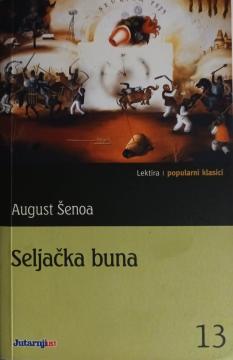
Seljačka buna

Seljačka buna

August Šenoa

The Peasant Revolt is a historical novel by August Šenoa, first published in the magazine Vijenac in 1877. It is one of five novels by August Šenoa and his most important historical novel. The introductory judge was written by Josip Nagy.

The novel is set in northern Croatia, at a time of great social injustice and feudal cruelty. Through a rich gallery of characters, Šenoa depicts a sharp division between oppressed peasants and powerful nobles.

The main characters include Matija Gubec, the leader of the rebellion, who is portrayed as a just, brave, and prudent peasant, and Baron Franz Tahy, a cruel nobleman whose abuses instigated the uprising. They are joined by Petar, a young peasant and fighter for justice, and his love Dora, who brings an emotional dimension to the story.

The peasants organize and rise up against the lordly tyranny, dreaming of a more just society in which everyone will be equal. Although initially successful, the rebels are ultimately defeated. Gubec is captured, tortured, and executed in Zagreb's St. Mark's Square, with which Šenoa concludes the story with a tragic but dignified ending.

The novel emphasizes the idea of ​​national unity, the struggle for freedom and justice, but also warns of the consequences of too rapid and poorly organized revolutions. Šenoa uses history as a framework for promoting humanistic and patriotic values, which gives the work a strong social message.

Illustrations
Zorislav Drempetić Hrčić
Graphics design
Halid Malla
Dimensions
19.5 x 13 cm
Pages
302
Publisher
Jutarnji list, Zagreb, 2004.
 
Latin alphabet. Paperback.
Language: Croatian.
ISBN
9-53-716044-0

Two copies are available

Copy number 1

Condition:Used, excellent condition

Copy number 2

Condition:Used, excellent condition
 

Are you interested in another book? You can search the offer using our search engine or browse books by category.

You may also be interested in these titles

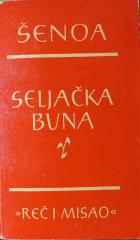
Seljačka buna

Seljačka buna

August Šenoa
Rad, 1964.
Serbian. Latin alphabet. Paperback.
2.98 - 2.99
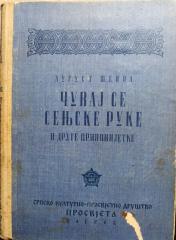
Čuvaj se Senjske ruke

Čuvaj se Senjske ruke

August Šenoa
SKD Prosvjeta, 1951.
Serbian. Cyrillic alphabet. Hardcover.
9.99
Čuvaj se Senjske ruke

Čuvaj se Senjske ruke

August Šenoa
Zora, 1962.
Croatian. Latin alphabet. Paperback.
4.88 - 4.99
Deobe 1-3

Deobe 1-3

Dobrica Ćosić

This work, awarded the NIN Prize for that year, is considered one of the most significant in Serbian literature after World War II.

Prosveta, 1961.
Serbian. Cyrillic alphabet. Hardcover with dust jacket.
The book consists of 3 volumes
11.42
Usta puna zemlje

Usta puna zemlje

Branimir Šćepanović

The novel "Usta puna zemlje" (1970), the masterpiece of the Serbian writer Branimir Šćepanović, is a psychologically in-depth explorer of the limits of the human soul, solitude and existential freedom, reminiscent of Kafka and Camus.

BIGZ, 1987.
Serbian. Latin alphabet. Paperback.
3.98
Andrićeva lestvica užasa

Andrićeva lestvica užasa

Svetislav Basara

A Serbian writer known for his satirical novels, Andrić's Ladder of Horrors dissects the Balkan mentality through a parable of Yugo-nostalgia and national myths. The title alludes to Ivo Andrić as a litmus test for criticism – Balkans claim him or reject

24 sata, 2021.
Serbian. Latin alphabet. Paperback.
11.56