Gospođica Elza
Rare book
Antique

Gospođica Elza

Arthur Schnitzler

The novella Miss Elsa (1924) depicts the inner monologue of a young girl from the Viennese bourgeoisie who faces a moral dilemma, family ruin, and her own sexuality in just a few dramatic hours.

Miss Elsa is one of Arthur Schnitzler's most famous novels. The work is written in the form of an interior monologue (the stream of consciousness technique), which was very fashionable at the time. The action takes place over the course of one day in a luxury hotel in an Austrian mountain resort.

Nineteen-year-old Elsa, a beautiful and intelligent girl from a failed Viennese family, receives a telegram from her mother asking her to save her father from prison by asking for money from a rich businessman who is willing to help – but on the condition that Elsa appears before him naked. Schnitzler masterfully enters Elsa's head, depicting her thoughts, fears, pride, erotic fantasies, shame and despair. The novel is a brilliant psychological study of a young woman caught between social conventions, family duty and her own desire for freedom and dignity.

The work is considered one of the highlights of Schnitzler's oeuvre and an important example of Viennese Modernism. Critics often point it out for its radical honesty in its depiction of female sexuality and its critique of bourgeois hypocrisy. The novella is a powerful and disturbing work that still impresses today with its storytelling technique and depth of psychological analysis.

Original title
Fräulein Else
Translation
Vida Bravačić
Dimensions
17.5 x 12.5 cm
Pages
119
Publisher
Hrvatski štamparski zavod d.d., Zagreb, 1925.
 
Latin alphabet. Paperback.
Language: Croatian.

One copy is available

Condition:Used, very good condition
Damages or inconvenience notice:
  • Damaged back
 

Are you interested in another book? You can search the offer using our search engine or browse books by category.

You may also be interested in these titles

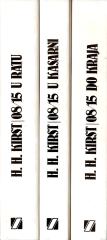
08/15: u kasarni / 08/15: u ratu / 08/15: do kraja

08/15: u kasarni / 08/15: u ratu / 08/15: do kraja

Hans Hellmut Kirst

Hans Hellmut Kirst's trilogy 08/15 follows soldier Asch from his life in the barracks, through the front and the post-war period. Through irony and dark humor, he exposes the senselessness of war, the moral collapse of the Wehrmacht, and a society that pr

Grafički zavod Hrvatske (GZH), 1981.
Croatian. Latin alphabet. Hardcover with dust jacket.
The book consists of 3 volumes
34.56
Kao suza u okeanu I-II

Kao suza u okeanu I-II

Manes Sperber

A trilogy by Austrian-French writer and psychologist Manès Sperber, which, through three novels – "Dust and Ashes", "In the Vortex" and "Memories and Shadows" – explores the themes of totalitarianism, ideological blindness and human suffering during the t

Matica srpska, 1997.
Serbian. Cyrillic alphabet. Paperback.
The book consists of two volumes
9.38
Na Rio de la Plati

Na Rio de la Plati

Karl May

The novel On the Rio de la Plata is the first part of a two-part adventure story by Karl May, continued in In the Cordilleras. The action takes place in South America, in Uruguay and Argentina, during the revolutionary turmoil of the 19th century.

Stvarnost, 1964.
Croatian. Latin alphabet. Hardcover.
5.38 - 6.84
Izabrane pjesme / Ausgewählte Gedichte

Izabrane pjesme / Ausgewählte Gedichte

Johann Wolfgang Goethe

A representative selection from the lyrics of Goethe, one of the greatest European poets, encompassing key phases of his work – from Sturm und Drang, through the classical Weimar period to his late poems.

Matica hrvatska, 2012.
Croatian. Latin alphabet. Paperback.
5.32
U Kordiljerima

U Kordiljerima

Karl May

In the Cordilleras (1894) is an adventure novel, a sequel to On the Rio de la Plata, part of May's South American cycle. The book follows adventures in Argentina during the revolutions, emphasizing themes of justice, forgiveness, and the struggle with the

Stvarnost, 1966.
Croatian. Latin alphabet. Hardcover.
4.52 - 7.32
Iskra života

Iskra života

Erich Maria Remarque

Spark of Life follows a group of inmates in a Nazi concentration camp who, despite the constant terror, retain their moral strength and humanity. The novel depicts the struggle of the spirit against systematic destruction and the need for hope.

Džepna knjiga, 1955.
Serbian. Latin alphabet. Paperback.
3.00 - 3.24