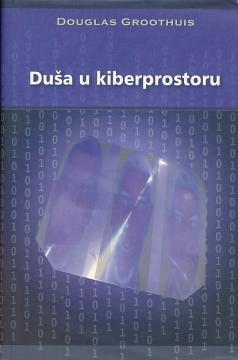
Duša u kiberprostoru

Duša u kiberprostoru

Douglas Groothuis

A philosophical analysis of the impact of the Internet and digital technology on ethics and human nature from a Christian perspective. Groothuis, a professor of philosophy, explores how cyberspace is changing the way people communicate, see truth, and exp

The book warns of the dangers of replacing real, physical relationships with virtual interactions, highlighting the loss of authenticity and depth in communication. Groothuis criticizes the illusion of "freedom from the body" that the Internet promotes, arguing that it dehumanizes the experience. It explores topics such as privacy, technology addiction, and information manipulation, warning of the erosion of moral values in the digital age. It focuses in particular on how the Internet can threaten Christian values, such as community and the search for truth, and how it can encourage superficiality in faith.

Despite the criticisms, Groothuis does not reject technology entirely, but calls for its responsible use, while preserving the human soul and ethical principles. The book combines philosophical analysis, theological insights, and practical examples, offering both warning and guidance for Christians in the digital world.

Although written in the early days of the Internet, the book remains relevant for its insightful observations about the impact of technology on society, especially in the context of today's digital ubiquity.

Original title
The Soul in Cyberspace
Translation
Davorin Peterlin
Editor
Bruna Filli-Terešak
Graphics design
Momir Blažek
Dimensions
22 x 15 cm
Pages
223
Publisher
STEPress, Zagreb, 2003.
 
Distribution: 1,000 copies
 
Latin alphabet. Hardcover with dust jacket.
Language: Croatian.
ISBN
978-9-53635-020-9

One copy is available

Condition:Unused
 

Are you interested in another book? You can search the offer using our search engine or browse books by category.

You may also be interested in these titles

Divlja Evropa

Divlja Evropa

Božidar Jezernik

At the center of Jezernik's scientific work is ethnological and anthropological research of the Balkans and Eastern Europe.

Biblioteka XX vek, 2007.
Serbian. Latin alphabet. Paperback.
9.98
Odrasti digitalno: Kako mrežna generacija mijenja vaš svijet

Odrasti digitalno: Kako mrežna generacija mijenja vaš svijet

Don Tapscott

Basing his book on research, the author explains how the network generation is shaping the world, why it is important to understand it, and how to "harvest" the great benefits it can provide.

Mate d.o.o, 2012.
Croatian. Latin alphabet. Paperback.
12.23
Internet galaksija: Razmišljanja o internetu, poslovanju i društvu

Internet galaksija: Razmišljanja o internetu, poslovanju i društvu

Manuel Castells

An indispensable sociological study by Manuel Castells, author of the trilogy “The Information Age.” The title alludes to McLuhan's “Gutenberg's Galaxy,” emphasizing that the Internet represents a new communications revolution.

Jesenski i Turk, 2003.
Croatian. Latin alphabet. Paperback.
11.52
Ljudski govor i jezici

Ljudski govor i jezici

Zvonimir Kulundžić

Kulundžić's book provides an accessible account of the origin of speech and the development of language, and is also an early part of his broader interest in the history of writing, books, and human communication.

Novo pokoljenje, 1949.
Croatian. Latin alphabet. Paperback.
6.46
Što su Česi?: kratki pregled činjenica i pokušaj objašnjenja

Što su Česi?: kratki pregled činjenica i pokušaj objašnjenja

Jan Patočka

In the book before you, Jan Patočka wrote a paradigmatic essay on the Central European identity of a Slavic people.

Durieux, 2000.
Croatian. Latin alphabet. Paperback.
7.74
Što je sociologija?

Što je sociologija?

Norbert Elias

A classic work by one of the most influential sociologists of the 20th century, the founder of "figurative" or "process" sociology. The book is a programmatic manifesto against the then dominant structural-functionalist paradigm (Parsons) and pure positiv

Antibarbarus, 2007.
Croatian. Latin alphabet. Paperback.
8.26