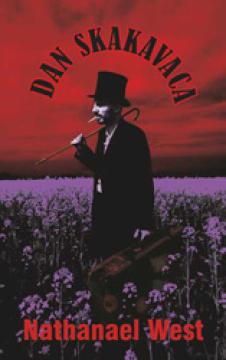
Dan skakavaca

Dan skakavaca

Nathaniel West

The Day of the Locust, which is reminiscent of the Old Testament plague, hovers mythically over the seemingly banal antics of "ordinary people".

The dark, raw, bloody, darkly humorous... side of the Hollywood "dream factory", all those rejected actors, ambitious parents and extras, red carpet enthusiasts, as well as the entire gallery of marginalized people are woven into this famous book. This is also the reason why it has been on many "millennial" best-of lists - Modern Library and Time magazine, among others, have included "The Day of the Locust" among the hundred best novels written in the English language in the twentieth century. Despite the seductive main character, the real (book) candy is the ambitious painter Hackett, resembling the American version of Kafka's Josef K., or Ulrich Robert Musil, or, if we are closer to us, Krležin's Filip Latinovicz. The next parallel can be connected with another of our "capitalists" Marinković and his Cyclops, and add Joyce's Ulysses - both titles just like West's. All of these parallels are interesting, and probably the most interesting is the similar devastating economic reality and the crisis of morality and true values ​​in the depression of the 1930s and this century's recession, which makes "The Locusts" very relevant today.

Original title
The day of the locust
Translation
Mirjana Zec Kekez
Editor
Krunoslav Jajetić
Illustrations
Mario Grobenski
Graphics design
Mario Grobenski
Dimensions
19 x 12 cm
Pages
220
Publisher
Šareni dućan, Koprivnica, 2012.
 
Latin alphabet. Paperback.
Language: Croatian.

One copy is available

Condition:Used, excellent condition
 

Are you interested in another book? You can search the offer using our search engine or browse books by category.

You may also be interested in these titles

Proces

Proces

Franz Kafka

Kafka wrote The Process between 1914 and 1915, published posthumously in 1925. The novel is unfinished but with an added final chapter by Max Brod. Edition with a foreword by B. Živojinović and an afterword by Walter Killi.

BIGZ, 1990.
Serbian. Latin alphabet. Paperback.
4.26
Brdo

Brdo

Ivica Prtenjača

It is a deeply disturbing text, full of emotions and traumatic experiences of a collapsed, imploded urban individual crying out for the meaning of life.

VBZ, 2014.
Croatian. Latin alphabet. Paperback.
7.82
Utočište

Utočište

Patrick Mcgrath

The Asylum (1996) by Patrick McGrath is a gothic psychological thriller, narrated by Dr. Peter Cleave, a psychiatrist at a maximum security mental institution in England in the 1950s. Dive into the darkness of passion that breaks down all walls...

Fidas, 1997.
Croatian. Latin alphabet. Hardcover.
8.36
Zagrepčanka

Zagrepčanka

Branislav Glumac

Branislav Glumac published a novel without periods or commas in 1974, as the relentless stream of thought of a young rebel. Published in socialist Yugoslavia, the work caused a scandal with its openness and became a classic about generational rebellion.

IROS, 1986.
Croatian. Latin alphabet. Hardcover.
8.24
Shannonov put

Shannonov put

Archibald Joseph Cronin

Cronin's moving story of redemption. Robert Shannon, a fanatical doctor-researcher, sacrifices love and life for science, but in the end loses everything – his girlfriend, recognition, health – only to realize through suffering: medicine without humanity

Otokar Keršovani, 1966.
Croatian. Latin alphabet. Hardcover with dust jacket.
6.24
Deobe 1-3

Deobe 1-3

Dobrica Ćosić

This work, awarded the NIN Prize for that year, is considered one of the most significant in Serbian literature after World War II.

Prosveta, 1961.
Serbian. Cyrillic alphabet. Hardcover with dust jacket.
The book consists of 3 volumes
11.42