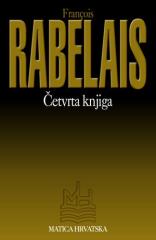
Gargantua
Rare book

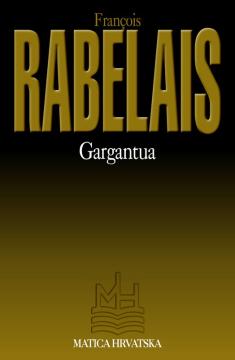
Gargantua

François Rabelais

The birth, childhood, upbringing and warlike exploits of the giant Gargantua: a satire on scholasticism, wars, monasticism and society, with grotesque humour, enormous eating/drinking and utopian ideals.

Gargantua (1534/1535) by François Rabelais (ca. 1494–1553) is the first (and most famous) part of the pentalogy about the giants Gargantua and Pantagruel. This edition by Matica Hrvatska brings the first complete translation of the book into Croatian, independently - later Pantagruel was published in 1996, the other books in 1997–1998, and the whole in 2004.

The novel begins with the genealogy and birth of Gargantua (from the ear of his mother Gargamela after an enormous feast), his childhood full of grotesque episodes (drinking rivers of wine, enormous quantities of food), then his poor scholastic upbringing in Paris (a satire on medieval education) and the transition to humanistic education under Ponocrates. It culminates in a war against King Picrochol (a parody of modern wars), where Gargantua fights victoriously, and the reward is the founding of the utopian monastery of Teljem – "Do what you will" (Fay ce que vouldras), where freedom, education and harmony are the opposite of ascetic monasticism.

Rabelais's style is furious, exuberant, full of vulgarisms, puns, lists, parodies of the Bible, ancient authors and medieval genres. Grotesque bodies (giant functions, eating, sex) serve to satire the Church, belligerence, scholasticism and social norms of the Renaissance. The work is humanistic, optimistic, celebrates life, knowledge and freedom, but also cynically mocks hypocrisy. Maras's translation is commendable for preserving the rhythm, humour and linguistic inventiveness of the original.

Original title
La vie très horrificque du grand Gargantua
Translation
Mate Maras
Editor
August Kovačec
Graphics design
Luka Gusić
Dimensions
16.7 x 11 cm
Pages
216
Publisher
Matica hrvatska, Zagreb, 1996.
 
Latin alphabet. Paperback.
Language: Croatian.

One copy is available

Condition:Used, excellent condition
Damages or inconvenience notice:
  • Slight damage to the cover
 

Are you interested in another book? You can search the offer using our search engine or browse books by category.

You may also be interested in these titles

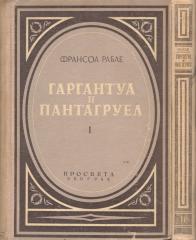
Gargantua i Pantagruel

Gargantua i Pantagruel

François Rabelais

Rabelais' masterpiece, a five-book novel cycle that follows the adventures of the giant Gargantua and his son Pantagruel. Vinaver, known for his linguistic virtuosity, masterfully conveys Rabelais's lavish humor, juicy swear words, and layered wordplay.

Kultura, 1950.
Serbian. Cyrillic alphabet. Hardcover.
The book consists of two volumes
11.34
Mjesec iznad Splita

Mjesec iznad Splita

Predrag Lucić

Predrag Lucić's second book of poetry, after "The Lovers from Verona" (2007), is a collection of irony, melancholy and contempt for canons - a dedication to the "ridicules" of Split, those who have woven their antics into the city's collective memory.

Algoritam, 2012.
Croatian. Latin alphabet. Paperback.
6.34
Ljepuškasta djeca

Ljepuškasta djeca

Jiří Šotola

The novel Beautiful Children depicts the world of adolescent rebels in a "re-education" colony - a prison disguised as a school. Written in the spirit of the Prague Spring, the work criticizes the communist system through a dynamic, cinematic narrative.

August Cesarec, 1986.
Croatian. Latin alphabet. Hardcover with dust jacket.
4.82 - 4.84
Blefsikon: Opera

Blefsikon: Opera

Peter Gammond

"Blefsikon: Opera" is a witty and insightful book that provides a satirical view of the world of opera.

Mozaik knjiga, 1996.
Croatian. Latin alphabet. Paperback.
2.64
Srce me je otkucalo: Aforizmi

Srce me je otkucalo: Aforizmi

Milovan Vitezović

Vitezović's aphorisms suggest a double reception to the modern reader in a certain, sensitive way.

BIGZ, 1989.
Serbian. Latin alphabet. Paperback.
3.98
Duhovitost duhovnih: Zgode pustinjskih otaca

Duhovitost duhovnih: Zgode pustinjskih otaca

Monah Dorotej

Today, both in the Church and in the world, we encounter many serious, worried, and thoughtful faces; there is too little cheerfulness, smiles, humor, and joy. This says a lot about us and our times.

Verbum, 2002.
Croatian. Latin alphabet. Paperback.
4.98