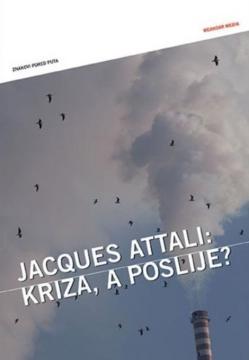
Kriza, a poslije?
After A Brief History of the Future, Jacques Attali writes a brief history of the present, dissecting the reasons that led to the first global financial crisis, the ways in which it manifests itself, and possible perspectives for the future.
The world seemed to be floating in a golden age: record global economic expansion, an abundance of cheap money, technological leaps, the spread of prosperity to new continents. And then, almost overnight, everything collapsed. The epicenter is America – ordinary citizens who can no longer repay mortgages on houses they bought on unsecured loans. But Attali shows that this is not an accidental accident, but the logical outcome of a system that has been built on unstable foundations for decades.
He leads the reader through a labyrinth: the deregulation of the financial sector that gave banks almost unlimited freedom, the explosion of "subprime" loans transformed into complex derivatives (such as CDOs and CDSs) that no one understood anymore, the greed of investment banks, hedge funds and rating agencies that made huge profits on false security ratings. All this against the background of deep social inequality – the rich were getting richer, and the middle class was artificially maintaining consumption only by borrowing. Globalization, in turn, allowed the virus to spread at lightning speed across the planet.
Attali does not stay only on the diagnosis. He warns that this is more than an economic crisis - it is a threat to democracy itself. If not changed, it may spawn a wave of nationalism, protectionism and even authoritarian regimes. Therefore, in the second part, it offers a way out: strict regulation of financial markets, transparency of dangerous instruments, strengthening of global coordination (as a precursor to some form of world governance), reduction of extreme inequality and transition to a more sustainable, less speculative growth model.
The book is written in a quick, lucid style - Attali does not want to impress experts, but to clarify the "mystery" of the crisis to a wider audience. It is particularly interesting that he himself already warned of the impending collapse in 2006, so his analysis sounds prophetic. Even today, years later, it remains a powerful reminder of how fragile that semblance of prosperity was and how important it is not to repeat the same mistakes.
One copy is available