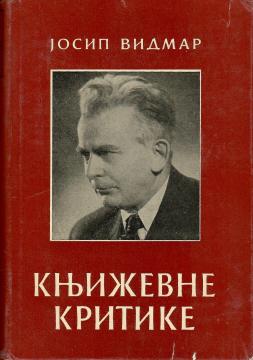
Književne kritike

Književne kritike

Josip Vidmar

Josip Vidmar's Literary Criticisms is a selection of the author's essays and criticisms on Slovenian literature – from Franc Prešeren to writers of the first half of the twentieth century.

Literary Criticisms by Josip Vidmar is the first edition in Serbo-Croatian, published in 1955 in Belgrade by the publisher Prosvet, in the prestigious Brazde Library (a library of contemporary Yugoslav writers). This edition represents a selection of Vidmar's most important criticisms and essays on Slovenian literature and is considered an antiquarian rarity among collectors of Yugoslav essays.

Vidmar (Ljubljana, 1895–1992) was a leading Slovenian literary critic, essayist, translator and cultural activist – academic, participant in the National Liberation War and long-time director of the Drama of the Slovenian National Theatre. His critical style is characterized by astuteness, high aesthetic criteria, analytical precision and the ability to combine aesthetic evaluation with historical and cultural context. He is often considered one of the greatest Slovenian critics, along with Fran Levstik.

The book includes criticism and essays on Slovenian writers from Franco Prešeren (a central figure in Slovenian literature) through realists and modernists of the 19th and 20th centuries (e.g. Fran Levstik, Ivan Cankar, Oton Župančič, Srečko Kosovel, etc.) to contemporary authors of the 1940s and 1950s. Vidmar traces the development of Slovenian literature, highlights key values, influences and artistic achievements, with critical assessments that often influenced the canon. His analyses of Prešeren, Cankar and other classics are particularly appreciated.

This edition follows Vidmar's Slovenian collections (Literary criticism, DZS 1951, etc.) and serves as an important bridge between Slovenian and other Yugoslav literatures in the post-war period. The criticisms reflect the author's deep knowledge of European literature and philosophy, and his style is clear, elegant and well-argued. The book is important not only as a survey of Slovenian literature, but also as an example of the high level of Yugoslav essayism and comparative criticism in the mid-20th century.

Translation
Dora Maksimović Pilković
Editor
Gvido Tartalja
Dimensions
19 x 13 cm
Pages
374
Publisher
Prosveta, Beograd, 1955.
 
Cyrillic alphabet. Hardcover.
Language: Serbian.

One copy is available

Condition:Used, excellent condition
 

Are you interested in another book? You can search the offer using our search engine or browse books by category.

You may also be interested in these titles

Zločin

Zločin

Ivan Potrč

Crime (1955) by Ivan Potrč is a historical novella that focuses on the last days of communist illegals Đuro Đaković and Nikola Hećimović, key figures of the Communist Party of Yugoslavia in the period between the two world wars.

Svjetlost, 1982.
Croatian. Latin alphabet. Hardcover.
4.28
Na valovima Mure Miška Kranjca

Na valovima Mure Miška Kranjca

Stjepko Težak
Radničko i narodno sveučilište Moša Pijade, 1963.
Croatian. Latin alphabet. Paperback.
3.98
Velika buna

Velika buna

Bratko Kreft

„Der große Aufstand“ ist ein historischer Roman des slowenischen Schriftstellers Bratko Kreft, der sich mit dem Bauernaufstand von 1573 auf dem Gebiet des heutigen Kroatien und Slowenien beschäftigt.

Spektar, 1974.
Croatian. Latin alphabet. Hardcover.
5.32
Ljudi ispod Osojnika

Ljudi ispod Osojnika

France Bevk

„Menschen unter Osojnik“ ist ein Roman der slowenischen Schriftstellerin Francet Bevko, der 1934 veröffentlicht wurde. Das Werk ist bekannt für seine realistische Darstellung des Lebens der Bauern an der slowenischen Küste in der ersten Hälfte des 20. Jah

Spektar, 1974.
Croatian. Latin alphabet. Hardcover.
3.62
Igra s đavolovim repom

Igra s đavolovim repom

Vitomil Zupan

Zupans Roman „Das Spiel mit dem Teufelsschwanz“ widmet sich ganz dem Thema, das in der slowenischen Literatur seit langem ein Tabuthema ist: der menschlichen Sexualität.

BIGZ, 1987.
Serbian. Latin alphabet. Paperback.
5.82
Drugovi I-II

Drugovi I-II

Tone Seliškar

A collection of short stories that follow the lives of young people, mostly pupils and students, during and after World War II, with an emphasis on their ideological struggle, maturation, and development of awareness of social changes.

Veselin Masleša, 1962.
Croatian. Latin alphabet. Hardcover.
The book consists of two volumes
6.32