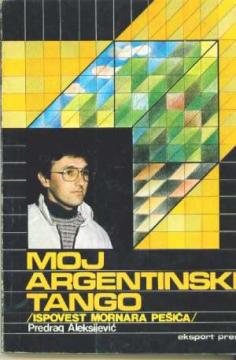
Moj Argentinski Tango - ispovest Mornara Pešića
Rare book

Moj Argentinski Tango - ispovest Mornara Pešića

Predrag Aleksijević

The book is an authentic, poignant, and humorous confession of the Belgrade sailor and bohemian Milorad Mornar Pešić (1934–2018), which Predrag Aleksijević wrote down and shaped into a confessional novel.

From the slums of old Dorćol, through the maritime school in Kotor, Pešić sailed the world's seas in the 1950s and 1960s on the ships of the "Jugolinija". The life of a sailor was his dream, but also an escape from the grayness of socialist Yugoslavia. In Buenos Aires in 1959, he accidentally entered a milonga and fell in love with Argentine tango - not just a dance, but a whole world of passion, sadness and dignity. He became obsessed, learned from old milongueras, danced in hidden salons, fell in love with fatal Argentine women and absorbed the culture that changed his life.

The book follows his adventures: from clashes with Peronists, overnight stays in brothels where tango is danced, to friendships with legendary dancers and musicians. Between voyages, he returned to Belgrade, where no one understood tango, so he danced it alone in an empty apartment with Piazzolla and Troilus.

"My Argentine Tango" is a story about the freedom that a Yugoslav found only far from his homeland, about the love of dance that "hurts while it is beautiful", and about a man who lived his whole life as if he were dancing - passionately, dangerously and to the end. The last chapter brings a touching return to Buenos Aires in 2017, when the old Sailor, sick and in a wheelchair, goes to his last milonga.

The book has become a cult among the tango community in Serbia and the region - a combination of an adventure novel, a memoir and a love letter to tango. Warm, sincere and irresistible.

Editor
Ljiljana Kovačević
Dimensions
20 x 14 cm
Pages
152
Publisher
NIRO Exportpress, Beograd, 1984.
 
Distribution: 5,000 copies
 
Latin alphabet. Paperback with dust jacket.
Language: Serbian.

One copy is available

Condition:Used, excellent condition
 

Are you interested in another book? You can search the offer using our search engine or browse books by category.

You may also be interested in these titles

Tri mušketira 1-2

Tri mušketira 1-2

Alexandre Dumas

Dumas' version of the story depicts the adventures of d'Artagnan and his friends from 1625 to 1628.

Epoha, 1966.
Croatian. Latin alphabet. Hardcover with dust jacket.
The book consists of two volumes
9.48
Dok ležah na samrti

Dok ležah na samrti

William Faulkner

Faulkner's 1930 novel, a classic example of modernist literature. It is often compared to Joyce's "Ulysses" for its innovative structure, but is more accessible due to its focus on family.

Rad, 1985.
Croatian. Latin alphabet. Paperback.
3.26
Pariški maraton : Knjiga pisanja (Pariz21. i 22. oktobar 2023)

Pariški maraton : Knjiga pisanja (Pariz21. i 22. oktobar 2023)

At the end of the eighties, Damir Uzunović traveled to Paris and stayed there for less than a year. He was twenty years old at the time, and that exile episode would be formative for the literature he would later write.

Buybook, 2024.
Croatian. Latin alphabet. Hardcover.
12.228.55
Andrićeva lestvica užasa

Andrićeva lestvica užasa

Svetislav Basara

A Serbian writer known for his satirical novels, Andrić's Ladder of Horrors dissects the Balkan mentality through a parable of Yugo-nostalgia and national myths. The title alludes to Ivo Andrić as a litmus test for criticism – Balkans claim him or reject

24 sata, 2021.
Serbian. Latin alphabet. Paperback.
11.56
Kreutzerova sonata, Hadži-Murat

Kreutzerova sonata, Hadži-Murat

Lav Nikolajevič Tolstoj

Kreutzer's sonata belongs to those works of Tolstoy that the writer adapted in many ways to his view on moral issues, on marital morality above all.

Civitas, 2004.
Croatian. Latin alphabet. Paperback.
4.98
Deobe 1-3

Deobe 1-3

Dobrica Ćosić

This work, awarded the NIN Prize for that year, is considered one of the most significant in Serbian literature after World War II.

Prosveta, 1961.
Serbian. Cyrillic alphabet. Hardcover with dust jacket.
The book consists of 3 volumes
11.42