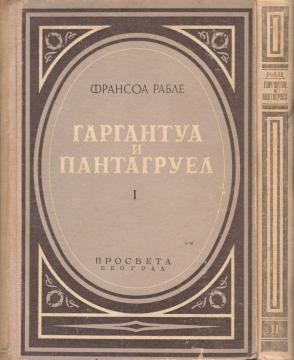
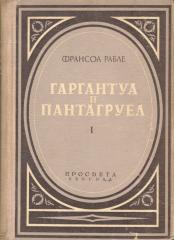
Gargantua i Pantagruel
Rijetka knjiga

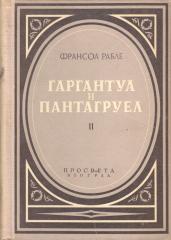
Gargantua i Pantagruel

François Rabelais

Rabelais' masterpiece, a five-book novel cycle that follows the adventures of the giant Gargantua and his son Pantagruel. Vinaver, known for his linguistic virtuosity, masterfully conveys Rabelais's lavish humor, juicy swear words, and layered wordplay.

The work represents a cycle of five books that combine satire, grotesque and humanist ideas. Written in the spirit of Renaissance optimism, the books follow the adventures of the giant Gargantua and his son Pantagruel, intertwining humor, philosophy and criticism of social norms. Rabelais parodies medieval scholasticism, church dogmatism and feudal structures, using lush language, obscenities and language games to celebrate life and freedom of thought.

In the first book, Pantagruel (1532), we meet Pantagruel, a giant born in miraculous circumstances, whose education and companionship with Panurge, a cunning friend, lead to comic and philosophical debates. Gargantua (1534) depicts the life of Pantagruel's father, mocking a meticulous education and promoting the humanist ideal of a balanced mind and body. The third book (1546) focuses on Panurge's marriage dilemma, exploring the themes of freedom and fate through witty dialogue. The Fourth (1552) and Fifth Books (1564, partly attributed to Rabelais) follow Pantagruel and Panurge's journey to the oracle of the Holy Bottle, parodying epic travel and religious fanaticism. Rabelais's "Pantagruelism" celebrates the joy of life, while criticizing hypocrisy and stupidity.

Vinaver’s translation is a masterpiece of Serbian literature. As a poet and translator, Vinaver masterfully conveys Rabelais’s linguistic multi-layeredness, preserving his humor, vulgar witticisms, and philosophical nuances. His coinages, such as “vasionska vitlarija” or “Šupeljko,” add a local touch, adapting the text to the reader. In his preface, Eli Finci emphasizes Vinaver’s ability to capture the “buzz of words” and the vitality of the original.

Although some have criticized Vinaver for allegedly overdoing it with vulgarity, analysis shows that he faithfully captures Rabelais’s ambivalent use of language, where swear words serve as satirical weapons. This translation, although five decades old, remains lively and relevant, making Rabelais’s work accessible and attractive to modern readers, while preserving the Renaissance spirit and criticism of society.

Naslov izvornika
Les cinq livres de Gargantua et Pantagruel
Prijevod
Stanislav Vinaver
Urednik
Raško Dimitrijević
Dimenzije
20,5 x 14,5 cm
Ukupan broj strana
809
Nakladnik
Kultura, Beograd, 1950.
 
Ćirilica. Tvrde korice.
Jezik: Srpski.

Knjiga se sastoji od dva toma.

Jedan višetomni primjerak je u ponudi.
Dodano u košaricu!

Gargantua i Pantagruel
Prvi tom
Broj strana: 467
Stanje:Korišteno, u vrlo dobrom stanju
Oštećenja / nepogodnosti:
  • The cover is missing
Gargantua i Pantagruel
Drugi tom
Broj strana: 343
Stanje:Korišteno, u vrlo dobrom stanju
Oštećenja / nepogodnosti:
  • The cover is missing
 

Zanima Vas i neka druga knjiga? Možete pretražiti našu ponudu pomoću tražilice ili prelistati knjige po kategorijama.

Možda će Vas zanimati i ovi naslovi

Gargantua

Gargantua

François Rabelais

The birth, childhood, upbringing and warlike exploits of the giant Gargantua: a satire on scholasticism, wars, monasticism and society, with grotesque humour, enormous eating/drinking and utopian ideals.

Matica hrvatska, 1996.
Hrvatski. Latinica. Broširano.
8,32
Evgenija Grande

Evgenija Grande

Honore de Balzac

"Eugénie Grandet" (1833), part of Balzac's Human Comedy, is a realistic novel that explores greed, family relationships, and the sacrifices of love in provincial French society.

Veselin Masleša, 1989.
Hrvatski. Latinica. Tvrde korice.
4,98
Ljubavnici sa Tahoa

Ljubavnici sa Tahoa

Joseph Kessel

The plot is set in Lisbon, along the Tagus River, and follows an emotional and complex love story intertwined with dramatic elements.

Minerva, 1987.
Srpski. Latinica. Tvrde korice.
4,983,98
A što ako vrijeme ne postoji?

A što ako vrijeme ne postoji?

Carlo Rovelli

Ten years before he discovered the theory of general relativity, Einstein realized that time and space were not two separate entities, but two aspects of one and the same entity.

Tim press, 2015.
Hrvatski. Latinica. Broširano.
6,78
Vrijeme nasilja

Vrijeme nasilja

Jean-Pierre Simon

A Time of Violence (1966) is an anti-war and activist novel by French writer Jean-Pierre Simon, a lesser-known author from the mid-20th century, whose work bears traces of leftist literature of the 1930s and 1940s.

Svjetlost, 1965.
Hrvatski. Latinica. Broširano.
2,46
Baselska zvona

Baselska zvona

Louis Aragon

The novel follows three women: Diane, a noblewoman; Catherine Simonidzé, a feminist; and the real Clara Zetkin, a communist. Through their destinies, the crisis of bourgeois society, women's emancipation, and the path to communism are depicted.

Kultura, 1946.
Srpski. Latinica. Tvrde korice.
5,76