Granica
Ein rares Buch

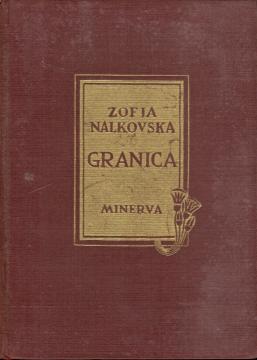
Granica

Zofia Nałkowska

Through the fate of the ambitious Zenon Ziembiewicz, the novel Granica depicts the transgression of moral, social and human boundaries – careerism, class differences and the price of compromise in interwar Polish society.

The Border (1935) is one of Zofia Nałkowska’s most significant works and the pinnacle of Polish psychological and social prose of the interwar period. The novel has a complex structure – it begins with the death of the main character Zenon Ziembiewicz, and then his life is reconstructed through retrospection.

Zenon Ziembiewicz, the son of an estate manager, is an ambitious and capable young man who quickly climbs the social ladder – from journalist to mayor. On the way to success, he crosses several “borders”: moral (betrays love and responsibility), class (exploits lower social classes) and human (loses inner purity). The story centers on two female characters: Elżbieta Biecka, a refined and cold member of the upper class, and Justyna Bogutówna, a poor, naive and emotional girl from the people whom Zenon seduces and abandons.

Nałkowska masterfully analyzes the mechanisms of careerism, the hypocrisy of bourgeois society, class divisions and moral relativity. The novel shows how an individual, in his pursuit of success and power, gradually loses the boundaries between good and evil, truth and lies, love and benefit. The criticism of patriarchal society and the fate of women in it is particularly strong.

The style is precise, psychologically deep and analytical, with elements of social satire. Nałkowska does not judge the characters directly, but rather depicts them in all their contradictions, leaving the reader to reflect on the limits of human action.

The Border is considered a classic of 20th-century Polish literature and an important testimony to the moral crisis of European civil society on the eve of World War II.

Übersetzung
Duša Perović
Editor
Tanasije Mladenović, Risto Tošović
Illustrationen
Nada Doroški
Titelseite
Stevan Vujkov
Maße
20 x 14 cm
Seitenzahl
306
Verlag
Minerva, Subotica, 1956.
 
Latein Schrift. Hardcover.
Sprache: Serbisch.

Angeboten wird ein Exemplar

Zustand:Gebraucht, in sehr gutem Zustand
Nachteile/Unannehmlichkeiten:
  • Traces of patina
Zum Warenkorb hinzugefügt!
 

Interessieren Sie sich für ein anderes Buch? Sie können das Angebot über unsere Suchmaschine suchen und finden oder Bücher nach Kategorien durchsuchen.

Diese Titel könnten Sie auch interessieren

Sanjar

Sanjar

Wladyslaw St. Reymont

The novel The Dreamer by Polish Nobel laureate Władysław Stanisław Reymont, published in Croatian in 1944, is an introspective and philosophically tinged work that differs from his more famous realistic novels such as The Peasant.

Suvremena biblioteka, 1944.
Kroatisch. Latein Schrift. Hardcover.
6,224,35
Seljaci II: Zima

Seljaci II: Zima

Władysław Stanisław Reymont

The second part of the epic tetralogy Peasants. The novel depicts the difficult winter life in the village of Lipce, deepens the conflicts within Boryna's family, the passionate relationship between Antko and Jagna, and the growing tensions in the village

Matica hrvatska, 1936.
Kroatisch. Latein Schrift. Hardcover.
23,54 (sammlung)
Obećana zemlja 1-2

Obećana zemlja 1-2

Władysław Stanisław Reymont

The novel The Promised Land, published in 1899, is one of the most significant works by Polish Nobel Prize winner Władysław Reymont. Set in the industrial city of Łódź at the end of the 19th century, the novel depicts rapid industrialization and its conse

Zabavna biblioteka - Naklada tiskare Narodnih novina, 1932.
Kroatisch. Latein Schrift. Hardcover.
Das Buch besteht aus zwei Bänden
13,24
Seljaci III: Proljeće

Seljaci III: Proljeće

Władysław Stanisław Reymont

The third part of the epic tetralogy The Peasants. Spring brings the awakening of nature, but also new conflicts in the village of Lipce: the culmination of a love triangle, family drama and social tensions. The continuation of Nobel's epic of Polish peas

Matica hrvatska, 1934.
Kroatisch. Latein Schrift. Hardcover.
7,32 - 23,54 (sammlung)
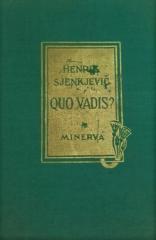
Quo vadis?

Quo vadis?

Henryk Sienkiewicz

The novel Quo Vadis depicts the love between the Roman patrician Marcus Vinicius and the Christian Lygia during the reign of Emperor Nero, and the conflict between the cruelty of the Roman Empire and Christian values.

Helmut Lingen Verlag, 1977.
Deutsch. Latein Schrift. Fester Einband mit Schutzumschlag.
12,42