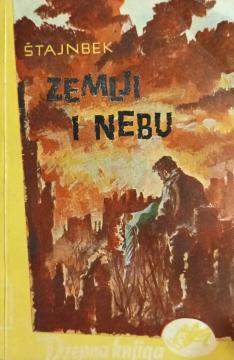
Zemlji i nebu

Zemlji i nebu

John Steinbeck

Steinbeck's early work from 1933, written with difficulty, announces motifs from East of Eden. A hit among lovers of mysticism and ecology - a mystical novel about man's deep connection with the earth and the conflict between pagan spirituality and Christ

The main character, Joseph Wayne, the third son of rancher John Wayne, leaves his home in Vermont with his father's blessing and heads for California. There, in the Nuestra Señora Valley, he buys a ranch under a large oak tree, which he feels is the embodiment of his father's spirit. He invites his brothers to join him on neighboring lands: the eldest, Burton, a devout Christian married to Harriet; Thomas, an animal lover married to a strong-willed woman, Rama; and the youngest, Benjy, an irresponsible drunk married to Jennie. Together they build a family estate.

Joseph marries literature teacher Elizabeth McGregor from Monterey, who bears him a son, little John. He hires Juanito, a faithful vaquero (who claims Castilian descent but is of Indian descent), who introduces him to local legends about periodic "dry years" and a sacred, eerie, moss-covered stone by a spring in a pine forest - a place of awe and worship.

Benjy's infidelity leads to tragedy: Juanito stabs and kills him after catching him seducing his wife Alice. Overwhelmed with guilt, Juanito begs Joseph to kill him in revenge, but Joseph refuses, suggesting they cover it up as an accident. Juanito runs away, promising to return one day.

Inspired by the advice of an old Mexican, Joseph organizes a pagan New Year's fiesta full of debauchery and dancing, which horrifies Burton, who - under the influence of the strict Christianity of the priest Father Angelo - armors the oak tree in anger, symbolically killing Joseph's "god".

Without rain in winter come terrible drought years, destroying crops and livestock. To calm Elizabeth's fear of the sacred field, Joseph takes her there; she climbs on a moss-covered stone, slips, breaks her neck and dies. Devastated, Joseph leaves little John to Rama and remains alone.

As the spring dries up and the land seems dead, Joseph realizes that he is its living heart. In a final sacrifice, he slits his wrists on the sacred stone, spilling his blood to “water” it. As he breathes his last, rain finally falls, renewing the valley.

Naslov originala
To a God Unknown
Prevod
Olivera Stefanović
Urednik
Risto Trifković
Naslovnica
Mirko Stojnić
Dimenzije
17 x 11 cm
Broj strana
253
Izdavač
Svjetlost, Sarajevo, 1961.
 
Latinica. Broširano.
Jezik: Srpski.

Jedan primerak je u ponudi

Stanje:Korišćeno, u odličnom stanju
Dodato u korpu!
 

Zanima Vas i neka druga knjiga? Možete pretražiti našu ponudu pomoću pretrage ili prelistati knjige po kategorijama.

Možda će Vas zanimati i ovi naslovi

Deobe 1-3

Deobe 1-3

Dobrica Ćosić

Ovo delo, nagrađeno NIN-ovom nagradom za tu godinu, smatra se jednim od najznačajnijih u srpskoj književnosti posle Drugog svetskog rata. Prvo izdanje.

Prosveta, 1961.
Srpski. Ćirilica. Tvrde korice s omotom.
Knjiga se sastoji od tri toma
11,42
Malena je ime tanga

Malena je ime tanga

Almudena Grandes

Ako volite sirovu erotiku poput „Atlasa u oblaku“, ovo je senzualna saga – emotivna, provokativna, za one koji žele da osete puls zabranjene strasti! Grandes istražuje da li je ljubav kletva ili oslobođenje?

Mozaik knjiga, 2000.
Hrvatski. Latinica. Tvrde korice.
8,54
Rudnik čvaraka

Rudnik čvaraka

Tomislav Šovagović

Das Debütwerk des kroatischen Schriftstellers Tomislav Šovagović, der 2012 mit dem Josip-und-Ivan-Kozarac-Preis ausgezeichnet wurde, ist eine Widmung an Slawonien – die Region seiner Kindheit, die der in Dalmatien geborene Autor mit fremden, aber zärtlich

Mozaik knjiga, 20112.
Hrvatski. Latinica. Broširano.
11,56
Krčma

Krčma

Julian Stryjkowski

Das 1977 erschienene Buch „Inn“ von Julian Stryjkowski untersucht das Leben in einem kleinen jüdischen Dorf in Galizien im 19. Jahrhundert.

BIGZ, 1977.
Srpski. Latinica. Broširano.
4,38
Deobe

Deobe

Dobrica Ćosić

„Deobe“ ist ein Roman über die tragische Spaltung der Serben in Tschetniks und Partisanen während des Zweiten Weltkriegs. Der mit dem NIN-Preis ausgezeichnete Roman ist Teil einer größeren epischen Trilogie, die von Ćosićs Erfahrungen und historischen Dok

Prosveta, 1963.
Hrvatski. Latinica. Tvrde korice s omotom.
13,74
Usta puna zemlje

Usta puna zemlje

Branimir Šćepanović

Der Roman „Usta puna zemlje“ (1970), das Meisterwerk des serbischen Schriftstellers Branimir Šćepanović, ist eine psychologisch tiefgründige Erkundung der Grenzen der menschlichen Seele, der Einsamkeit und der existenziellen Freiheit, die an Kafka und Cam

BIGZ, 1987.
Srpski. Latinica. Broširano.
3,96 - 3,98