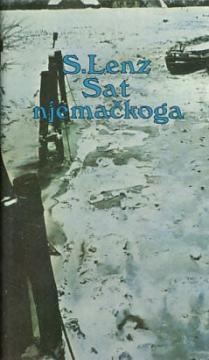
Sat njemačkoga

Sat njemačkoga

Siegfried Lenz

The German Hour (1968) by Siegfried Lenz is a German novel that deals with themes of duty, obedience, and moral responsibility in the context of Nazi Germany, told through the perspective of the young Sigi Jensen.

The story unfolds in two time periods: the 1950s, as Sigi writes an essay in a reformatory, and the 1940s, through memories of his life in the village of Rugbüll.

Sigi, the son of policeman Jens Ole Jensen, recalls his father's obsessive obedience to the Nazi regime. Jens, tasked with enforcing a painting ban on the artist Max Ludwig Nansen, who has been labeled a "degenerate", becomes increasingly obsessed with his duty, despite having once been a friend of the artist. Max, inspired by the North Sea landscape, continues to paint despite the ban, which causes conflict with Jens. Sigi, torn between admiration for the artist and loyalty to his father, witnesses how fanaticism destroys family and personal relationships. His rebellion against his father's blind obedience leads him into conflict with the authorities, culminating in his imprisonment.

The novel, written in the form of Sigi's essay, examines how authority and obedience stifle individuality and morality. Through rich descriptions and psychological depth, Lenz creates a powerful critique of Nazism and conformism, while the North Sea landscape symbolizes freedom and resistance. The work is a universal story of the conflict between conscience and duty, with a message about the importance of personal integrity.

Original title
Deutschstundf
Translation
Leo Držić
Editor
Milan Mirić
Graphics design
Alfred Pal
Dimensions
21 x 12.5 cm
Pages
425
Publisher
Sveučilišna naklada Liber (SNL), Zagreb, 1979.
 
Latin alphabet. Hardcover with dust jacket.
Language: Croatian.

One copy is available

Condition:Used, excellent condition
 

Are you interested in another book? You can search the offer using our search engine or browse books by category.

You may also be interested in these titles

Kafkina tajna: Tumačenje Kafkinih "Razmišljanja o grijehu, patnji, nadi i pravom putu"

Kafkina tajna: Tumačenje Kafkinih "Razmišljanja o grijehu, patnji, nadi i pravom putu"

Konrad Dietzfelbinger

An in-depth analysis of Kafka's aphorisms from the collection Reflections on Sin, Suffering, Hope and the True Path. The study explores Kafka's spiritual dimension, highlighting him as an esotericist who expresses universal truths about human existence th

Globus, 1993.
Croatian. Latin alphabet. Paperback.
9.32
Anđeo sa zapadnog prozora

Anđeo sa zapadnog prozora

Gustav Meyrink

The Angel of the West Window is a strange fictional novel by Gustave Meyrink steeped in alchemical, hermetic, occult and mystical imagery and ideas, interweaving the life of Elizabethan magician Dr. John Dee with that of a fictional modern descendant, Bar

NIRO Književne novine, 1982.
Serbian. Latin alphabet. Paperback.
The book consists of two volumes
15.42
Sablast Llana Estacada

Sablast Llana Estacada

Karl May

An adventure novel by Karl May, part of the Wild West series. The story takes place on the dangerous, arid Llano Estacado plain in Texas and New Mexico, known for its mysterious phenomena and crimes.

Mladost, 1963.
Croatian. Latin alphabet. Paperback with dust jacket.
3.52
Zatvorenik

Zatvorenik

Sebastian Fitzek

A missing child. Desperate father. A terrifying secret. In The Prisoner, master of psychological thrillers Sebastian Fitzek takes readers on a tense and unpredictable journey through the darkest corners of the human psyche.

Mozaik knjiga, 2024.
Croatian. Latin alphabet. Paperback.
10.38
Josip i njegova braća III: Josip u Egiptu

Josip i njegova braća III: Josip u Egiptu

Thomas Mann

The third part of the tetralogy by German Nobel Prize winner Thomas Mann, Joseph and His Brothers, is entitled Joseph in Egypt. This tetralogy is considered one of the most important works by Thomas Mann, as well as by German literature of the twentieth c

Fraktura, 2010.
Croatian. Latin alphabet. Hardcover with dust jacket.
34.62
Poezija i zbilja

Poezija i zbilja

Johann Wolfgang Goethe

Goethe's greatest autobiographical prose, written between 1811 and 1833, covers his life from his birth in 1749 in Frankfurt to 1775, when he went to Weimar at the invitation of Duke Karl August.

Matica hrvatska, 1953.
Croatian. Latin alphabet. Hardcover with dust jacket.
18.42