Spovid općena
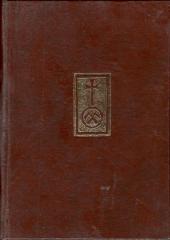
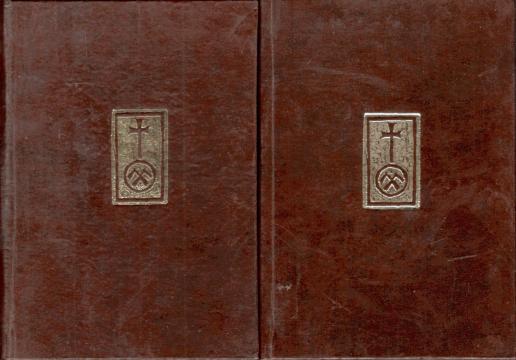
Reprint of the book "Spovid općena" (1496), the first printed book in the Croatian language and in the Glagolitic script. Very rare bibliophile edition. Reprint of the Glagolitic text in one booklet, and in the other a Latin transcription, prepared by Ani
"Spovid općena" (1496), the first printed book in the Croatian language and in the Glagolitic script, is a significant monument of Croatian literature and printing. It was printed in the Senj Glagolitic printing press, the second such printing press in Croatia after Kosinj, which operated from 1494 to 1508. The book is a translation of the popular Franciscan manual Confessionale generale by the Milanese preacher Michele Carcano, and was translated by Jakov Blažiolović, later the bishop of Senj. The text is written in the Čakavian dialect with elements of Old Church Slavonic and Italianisms, which shows linguistic diversity and the effort in shaping Croatian theological terminology. It contains 36 leaves (71 pages) and is printed in monochrome, in black, in a small format on paper, without graphic decorations, with the text arranged in 25 lines per page. The only surviving copy is kept in the library of the Monastery of St. Francis Xavier in Zagreb. The colophon of the book states that it was printed by Blaž Baromić on 25 April 1496 in Senj.
The General Confession was written in the context of the need for a manual that would make it easier for priests to perform the sacrament of confession. The translation by Jakov Blažiolović is based on Carcan's work, which was widely used in Europe. The book provides instructions for confessors, lists of sins according to the Ten Commandments and the Seven Deadly Sins, and moral guidelines, reflecting medieval church practice. Printing enabled wider distribution, giving Glagolitics a standardized text for pastoral work. The book's significance lies in its role as the first non-liturgical incunabula in the Croatian language, highlighting the cultural and linguistic identity of the Croats.
The Senj printing house was founded by the Senj canon Blaž Baromić, who in 1493 in Venice, in the printing house of Andrija Torresani, acquired knowledge of the printing trade and supervised the printing of the Glagolitic Baromić Breviary. In 1494, he founded a printing house in Senj, next to the bell tower of the Senj Cathedral, in the house of Archdeacon Silvestro Bedričić, the owner of the printing house. The printing house used Glagolitic letters brought from Venice, and Baromić designed the graphic inventory, including unique signs for half letters, which allowed for flexible combinations of letter groups – an innovation in European printing of the time. The printing house produced seven works from 1494 to 1508, including the Senj Glagolitic Missal (1494), the General Confession (1496), the Transit of Saint Jerome (1508), the Miracles of the Glorious Virgin Mary (1507), the Plebanus' Order (1507), the Master of the Good Dead with the Ritual (1507), and the Lenten Book (1508). Liturgical books were printed in two colors (black and red), while non-liturgical books, such as the General Confession, were printed in one color. The printing house operated with the permission of Bishop Philip of Senj, obtained from Pope Innocent IV in 1248, which allowed for the Glagolitic liturgy. The circulation of the books is not known, but copies are extremely rare, often surviving in only one copy.
The Senj printing house was crucial for the preservation of the Glagolitic tradition and the spread of the Croatian language in printed form. The General Epistle represents a bridge between medieval religious practice and early printing, and its 1978 reprint (facsimile edition and Latin transcription by Anica Nazor) has enabled further study. The work and the printing house bear witness to the technical and cultural sophistication of Croatian Glagolitic writers at the end of the 15th century.
The book consists of two volumes.
Jedan višetomni primjerak je u ponudi.