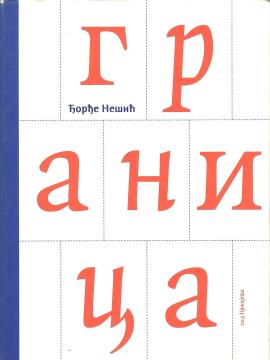
Granica

Granica

Đorđe Nešić

The collection is one of Nešić's key books from the post-war period of the 1990s, when he faced exile, minority status, and identity fractures on the border of two worlds – Croatian and Serbian, Slavonian and Danube.

The title "Border" is a multi-layered symbol: a physical border (the Danube, the state line), a border between the past and the present, life and death, memory and oblivion, and the border of humanity in war and the post-war period. The poems are intimate, melancholic, with strong homeland motifs: the Danube as an eternal river that carries memories, the villages of Bijelo Brdo and Dalj, vineyards, houses, people who stayed or left.

Nešić writes about the minority position of Serbs in Croatia – about silence, fear, loss of language and culture, but also about resistance through poetry and memory. The verses are precise, rhythmic, with a touch of lyrical minimalism and deep sadness, but without pathos – more contemplative than accusatory. The border becomes a place of encounter and separation, where identity is sought in fragments.

The collection is part of Nešić's oeuvre dedicated to homeland, gender, and language (along with "The Window Through Which the Danube Flows", "It's Better to Be in the Minority"). It is valued in Serbian literature in Croatia as a testament to the survival of culture on the edge, with an emphasis on the silent power of words as a barrier against oblivion.

Editor
Čedomir Višnjić
Dimensions
18 x 13 cm
Pages
60
Publisher
SKD Prosvjeta, Zagreb, 2006.
 
Cyrillic alphabet. Paperback with dust jacket.
Language: Serbian.

One copy is available

Condition:Used, excellent condition
 

Are you interested in another book? You can search the offer using our search engine or browse books by category.

You may also be interested in these titles

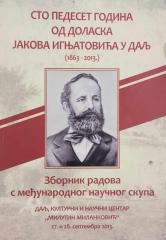
Sto pedeset godina od dolaska Jakova Ignjatovića u Dalj (1863.-2013.)

Sto pedeset godina od dolaska Jakova Ignjatovića u Dalj (1863.-2013.)

Đorđe Nešić

Proceedings of the international scientific conference held in 2013 in Dalj, on the occasion of the 150th anniversary of the arrival of the Serbian realist writer Jakov Ignjatović (1822–1889) in Dalj.

Kulturni i znanstveni centar Milutin Milanković, 2014.
Serbian. Cyrillic alphabet. Paperback.
4.98
Luk i voda: Zavičajni rječnik s ušća Drave u Dunav

Luk i voda: Zavičajni rječnik s ušća Drave u Dunav

Đorđe Nešić

Luk i Voda is a poetic local dictionary from the confluence of the Drava and Danube rivers (Bijelo Brdo, Dalj, Baranja). Over 1600 entries preserve the dialect, customs, plants, dishes and spirit of the Danube region – an intimate monument to a language a

SKD Prosvjeta, 2012.
Croatian. Latin alphabet. Hardcover.
12.7610.21
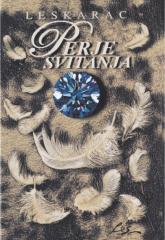
Biserje samoće

Biserje samoće

Stevo Leskarac

Colors are bright, sounds are clear, and smells are intoxicating in the poetry of Steve Leskarca (Dubica, 1963), who sings about the beauty of nature and the joy of love, even though he is aware of life's bitterness, which becomes "at least a little sweet

Beletra, 2023.
Croatian. Latin alphabet. Hardcover.
14.52
Metropola

Metropola

Davor Jurić

Poetry collection by authors of the youngest generation of Croatian poetry.

Meandar, 1999.
Croatian. Latin alphabet. Paperback.
4.983.98
Njegov posljednji san - iz ostavštine

Njegov posljednji san - iz ostavštine

Zdenka Marković

The book "His Last Dream" by Zdenka Marković from 2007 is a collection of her legacy works, including letters, prose, poems and the drama "Tragedy".

Društvo hrvatskih književnika, 2007.
Croatian. Latin alphabet. Hardcover.
12.96
Ribanje i ribarsko prigovaranje

Ribanje i ribarsko prigovaranje

Petar Hektorović

Fishing and Fisherman's Complaint by Hvar nobleman and poet Petar Hektorović (Stari Grad, 1487-1572) is an anthology and one of the most significant works of Croatian Renaissance literature.

Školska knjiga, 1974.
Croatian. Latin alphabet. Paperback.
4.98