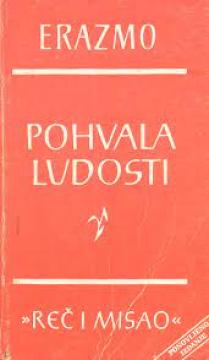
Pohvala ludosti
Retka knjiga

Pohvala ludosti

Erazmo Roterdamski

In "Praise of Folly", Erasmus observes all the nonsense of his time under a magnifying glass, criticizing the ancient authors themselves. Illustrations by Hans Holbein the younger taken from the Basel edition of 1676. Foreword by Veljko Korać.

The thread of a living ancient spirit runs through the work, partly through irony if Madness itself speaks, partly through completely serious considerations of theological and moral issues where the author seems to forget about Madness and speaks in his own language, like Erasmus. These two approaches are interwoven in the work, although the humorous tone of Madness is mostly dominant. Erasmus' irony is still close to us today because it is easily translatable to the reality of the modern world. It is possible to recognize the problems of human nature under the deposits of time, which actually remained the same even though the change in form created the appearance of a developed and emancipated society. In any case, we are amazed by Erasmus' openness and erudition, which gives this openness legitimacy, credibility based on a deep immersion in humanism. Erasmus is aware of the fact that people are neither able to follow nor avoid ethical imperatives, and that is why his sympathy is still on the side of human tragicomism. Among all the serious excursions into Erasmus' folly, the very end of the work should be singled out, in which the author speaks in Neoplatonic language about true happiness, the immortality of the spirit and the highest Good as the meaning of human life.

Naslov originala
Salutitiae laus
Prevod
Darinka Nevenić Grabovac
Urednik
Branislav Milošević
Naslovnica
Janko Krajšek
Dimenzije
19 x 12 cm
Broj strana
151
Izdavač
Rad, Beograd, 1984.
 
Latinica. Broširano.
Jezik: Hrvatski.

Jedan primerak je u ponudi

Stanje:Korišćeno, u vrlo dobrom stanju
Oštećenja / nepogodnosti:
  • Slight damage to the cover
Dodato u korpu!
 

Zanima Vas i neka druga knjiga? Možete pretražiti našu ponudu pomoću pretrage ili prelistati knjige po kategorijama.

Možda će Vas zanimati i ovi naslovi

Grad sunca

Grad sunca

Tommaso Campanella

The City of the Sun (Latin: Civitas Solis, published in 1623) is a visionary, esoteric, almost mystical utopia, deeply imbued with the Renaissance spirit, Egyptian astrology, and the Christian hope for a perfect society.

Kultura, 1964.
Srpski. Latinica. Tvrde korice.
7,52
Utopija

Utopija

Thomas More

In Utopia, Thomas More depicts an imaginary perfect society located on an isolated island, where the ruling principles of harmony, equality and reason overcome the imperfections of European society at the time.

Kultura, 1964.
Srpski. Latinica. Broširano.
6,34
Nikola Gučetić

Nikola Gučetić

Ljerka Šifler

The book by Ljerka Šifler-Premec (later known for her works on Renaissance philosophy, aesthetics, and Dubrovnik culture) represents the first comprehensive monograph on Nikola Vitov Gučetić, one of the most important Croatian thinkers of the late Renaiss

Studentski centar Sveučilišta u Zagrebu, 1977.
Hrvatski. Latinica. Broširano.
6,72
Machiavelli i njegova politička nauka: O četiristotoj obljetnici državnikove smrti (1527-1927)

Machiavelli i njegova politička nauka: O četiristotoj obljetnici državnikove smrti (1527-1927)

Vinko Lozovina

The book Machiavelli and His Political Science by Vinko Lozovina, published in 1928 on the occasion of the 400th anniversary of the death of Niccolò Machiavelli, presents a comprehensive analysis of the life, works, and political thought of this Renaissan

Matica hrvatska, 1928.
Hrvatski. Latinica. Tvrde korice.
9,36