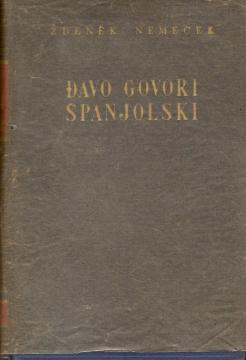
Đavo govori španjolski
Antique
Rare book

Đavo govori španjolski

Zdeněk Němeček

The novel tells a moving story about the Spanish Civil War. Through the fates of journalists, intellectuals and ordinary people, it depicts the brutality, ideological conflicts and demonic side of a war in which "the devil speaks Spanish".

The novel is inspired by and partly based on the author's own impressions and experiences from the Spanish Civil War. Němeček portrays the war not as a heroic struggle, but as a demonic tragedy in which ideologies clash, and the ordinary man becomes the victim. Through the characters of journalists, intellectuals, soldiers and civilians, the novel shows the horrors of war, terror on both sides (Franco and Republican), propaganda, betrayal and the senselessness of violence.

The title The Devil Speaks Spanish is symbolic — it suggests that in Spain at that time, evil speaks the language of passion, love and poetry, which makes it even more dangerous and insidious. Němeček does not take an open side, but critically depicts fanaticism, false ideals and suffering that war brings to everyone. The style is dynamic, reporter-like and dramatic, with strong anti-war and humanist messages.

The book was banned in Prague in 1939 after Franco's intervention, which testifies to its sharpness. It was well received in Croatia and Yugoslavia in 1940, as the Spanish Civil War was a very current topic among intellectuals.

The work is one of the most significant European novels about the Spanish Civil War written from a neutral, humanistic perspective. Today it is a rare antiquarian and sought after among lovers of interwar literature, war prose, and Czech literature.

Original title
Ďábel mluví španělsky
Translation
Marko Fotez
Editor
Slavko Batušić
Dimensions
19 x 13 cm
Pages
229
Publisher
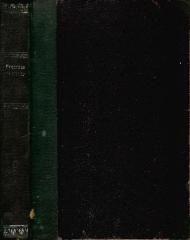
Savremena biblioteka, Zagreb, 1940.
 
Latin alphabet. Hardcover with dust jacket.
Language: Croatian.

One copy is available

In the original cardboard box.
Condition:Unused
 

Are you interested in another book? You can search the offer using our search engine or browse books by category.

You may also be interested in these titles

Moj put do Scapa Flowa: sa 8 slika

Moj put do Scapa Flowa: sa 8 slika

Günther Prien

Memoirs of the famous German submarine commander who in 1939 carried out one of the most daring submarine attacks in history – the sinking of the British battleship Royal Oak in Scapa Flow harbor.

Nakladni zavod Ante Velzek, 1942.
Croatian. Latin alphabet. Hardcover.
13.26
Baraka Pet Be i druge novele

Baraka Pet Be i druge novele

Miroslav Krleža

The collection "Baraka Pet Be i druge novele" brings a selection of Krleža's anti-war novels from the period 1916–1920s, focusing on the senselessness of World War I, the suffering of the Home Guard and the downfall of Austria-Hungary.

Mladost, 1987.
Croatian. Latin alphabet. Hardcover.
5.384.04
Zaboravljene djevojke

Zaboravljene djevojke

Martha Hall Kelly

The novel The Forgotten Girl is based on the real life of a member of New York's posh circles, who fought for the rights of Kunić, a group of women who survived the horrors of the Ravensbrück concentration camp.

Mozaik knjiga, 2018.
Croatian. Latin alphabet. Paperback.
7.98
Mila 18

Mila 18

Leon Uris

Mila 18 is a novel about the legendary uprising in the Warsaw ghetto. To write the novel, Uris spent years studying archival materials, visiting the places where the events took place and talking to survivors of the ghetto...

Matica hrvatska, 1970.
Croatian. Latin alphabet. Hardcover with dust jacket.
7.24
Putevi nesreće I: Fontana Mediči

Putevi nesreće I: Fontana Mediči

Joseph Kessel

Paris on the eve and during World War I. Young Richard Dalleau, full of ambition and a hunger for life, embarks on a journey of success, love and moral trials that will lead him into a vortex of misfortune.

Minerva, 1959.
Serbian. Latin alphabet. Hardcover.
6.54
Vrijeme nasilja

Vrijeme nasilja

Jean-Pierre Simon

A Time of Violence (1966) is an anti-war and activist novel by French writer Jean-Pierre Simon, a lesser-known author from the mid-20th century, whose work bears traces of leftist literature of the 1930s and 1940s.

Svjetlost, 1965.
Croatian. Latin alphabet. Paperback.
2.46