Moskva – Petuški
Rare book

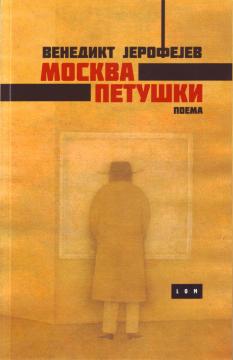
Moskva – Petuški

Venjedikt Jerofejev

Venedikt Yerofeyev's postmodern prose poem is today considered a classic of new Russian literature. It is compared to Gogol and Kharms for its poetics of absurdity, satire, and metaphysical depth.

Moscow – Petushki is a postmodern prose poem by Venedikt Yerofeyev (1938–1990), written in 1969–1970 in samizdat, published in Russia only in 1989 (during perestroika), and today it is considered a classic of new Russian literature and the last great Soviet myth. It is compared to Gogol and Kharms for its poetics of absurdity, satire, and metaphysical depth.

The story is pseudo-biographical: the lyrical hero Venichka (the author's alter ego) is a thirty-year-old alcoholic intellectual, fired from his job for drawing diagrams of how much workers drank. On Friday morning, he wakes up in an unfamiliar staircase in Moscow after several days of drunkenness, remembering nothing. He wants to go to Petushki (a real town 125 km east of Moscow) – an ideal, utopian space of love, where a “unique” lover and a three-year-old son (not necessarily his) await him. At Kursk Station, he buys alcohol and boards an electric train.

The journey is an alcoholic monologue: Venichka mixes incredible cocktails (“the tear of a kermesinka”, “the first kiss”, “the tears of a bitch”), talks with fellow travelers, angels, demons, God, quotes the Bible (the words of Christ, the New Testament, death and resurrection), Russian literature, the Soviet press, philosophizes about the Russian people (“we are all like drunks, but each in his own way: one laughs in the face of the world, the other cries on his chest”), ephemerality, paralysis of the soul, courage from an early age. Petushki becomes a metaphor for an unattainable paradise – the more he drinks, the more he loses his orientation.

In reality, Venichka never reaches Petushki: in a delirium, he returns to Moscow, where he is attacked by unknown people in passing and stabbed in the neck (the author later died of throat cancer in 1990). The novel is cyclical – it begins and ends in Moscow, without leaving the circle.

Through humor, irony, blasphemy, and lyricism, Yerofeyev criticizes Soviet reality: the absurdity of bureaucracy, the spiritual emptiness, where alcohol becomes the only way out of the “absolute rot of society.” Alcohol is the engine of the story and a symbol – from euphoria to tragedy. Quotes from the Bible, Gogol, Dostoevsky, Byron, and Soviet propaganda create a dense intertextuality.

Original title
Москва — Петушки
Translation
Irena Lukšić
Editor
Flavio Rigonat
Dimensions
21 x 13.5 cm
Pages
173
Publisher
LOM, Beograd, 217.
 
Cyrillic alphabet. Paperback.
Language: Serbian.

One copy is available

Condition:Used, excellent condition
 

Are you interested in another book? You can search the offer using our search engine or browse books by category.

You may also be interested in these titles

Zagrepčanka

Zagrepčanka

Branislav Glumac

Branislav Glumac published a novel without periods or commas in 1974, as the relentless stream of thought of a young rebel. Published in socialist Yugoslavia, the work caused a scandal with its openness and became a classic about generational rebellion.

IROS, 1986.
Croatian. Latin alphabet. Hardcover.
8.24
Proces

Proces

Franz Kafka

Kafka wrote The Process between 1914 and 1915, published posthumously in 1925. The novel is unfinished but with an added final chapter by Max Brod. Edition with a foreword by B. Živojinović and an afterword by Walter Killi.

BIGZ, 1990.
Serbian. Latin alphabet. Paperback.
4.26
Aurorin poticaj

Aurorin poticaj

Erich Hackl

The work is based on a true event that occurred in Spain in 1933: Aurora Rodriguez killed her daughter Hildegart, a famous fighter for women's emancipation and a cult figure on the political scene of the time.

Mladost, 1990.
Croatian. Latin alphabet. Hardcover with dust jacket.
4.96 - 4.98
Eva Luna

Eva Luna

Isabel Allende

Eva Luna is a novel about a poor storyteller who weaves lives with words, written by Isabel Allende, the founder of Latin American magical realism. Published after the success of The House of the Spirits, this whirlwind of adventure combines love, revolut

Znanje, 1990.
Croatian. Latin alphabet. Hardcover with dust jacket.
8.36
Rudnik čvaraka

Rudnik čvaraka

Tomislav Šovagović

The debut work of Croatian writer Tomislav Šovagović, awarded the Josip and Ivan Kozarac Award in 2012, is a dedication to Slavonia – the region of his childhood that the author, born in Dalmatia, observes with foreign but tender eyes.

Mozaik knjiga, 20112.
Croatian. Latin alphabet. Paperback.
11.56
Andrićeva lestvica užasa

Andrićeva lestvica užasa

Svetislav Basara

A Serbian writer known for his satirical novels, Andrić's Ladder of Horrors dissects the Balkan mentality through a parable of Yugo-nostalgia and national myths. The title alludes to Ivo Andrić as a litmus test for criticism – Balkans claim him or reject

24 sata, 2021.
Serbian. Latin alphabet. Paperback.
11.56