Granica
Rare book

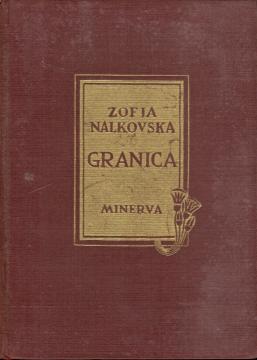
Granica

Zofia Nałkowska

Through the fate of the ambitious Zenon Ziembiewicz, the novel Granica depicts the transgression of moral, social and human boundaries – careerism, class differences and the price of compromise in interwar Polish society.

The Border (1935) is one of Zofia Nałkowska’s most significant works and the pinnacle of Polish psychological and social prose of the interwar period. The novel has a complex structure – it begins with the death of the main character Zenon Ziembiewicz, and then his life is reconstructed through retrospection.

Zenon Ziembiewicz, the son of an estate manager, is an ambitious and capable young man who quickly climbs the social ladder – from journalist to mayor. On the way to success, he crosses several “borders”: moral (betrays love and responsibility), class (exploits lower social classes) and human (loses inner purity). The story centers on two female characters: Elżbieta Biecka, a refined and cold member of the upper class, and Justyna Bogutówna, a poor, naive and emotional girl from the people whom Zenon seduces and abandons.

Nałkowska masterfully analyzes the mechanisms of careerism, the hypocrisy of bourgeois society, class divisions and moral relativity. The novel shows how an individual, in his pursuit of success and power, gradually loses the boundaries between good and evil, truth and lies, love and benefit. The criticism of patriarchal society and the fate of women in it is particularly strong.

The style is precise, psychologically deep and analytical, with elements of social satire. Nałkowska does not judge the characters directly, but rather depicts them in all their contradictions, leaving the reader to reflect on the limits of human action.

The Border is considered a classic of 20th-century Polish literature and an important testimony to the moral crisis of European civil society on the eve of World War II.

Translation
Duša Perović
Editor
Tanasije Mladenović, Risto Tošović
Illustrations
Nada Doroški
Graphics design
Stevan Vujkov
Dimensions
20 x 14 cm
Pages
306
Publisher
Minerva, Subotica, 1956.
 
Latin alphabet. Hardcover.
Language: Serbian.

One copy is available

Condition:Used, very good condition
Damages or inconvenience notice:
  • Traces of patina
 

Are you interested in another book? You can search the offer using our search engine or browse books by category.

You may also be interested in these titles

Španjolski vrtlar

Španjolski vrtlar

Archibald Joseph Cronin

Cronin's novel masterfully depicts the conflict between cold intellect and warmth of heart, the harmfulness of possessive love and the healing power of true human intimacy. The novel is at once a tender story about a child's soul and a sharp critique of e

Otokar Keršovani, 1966.
Croatian. Latin alphabet. Hardcover with dust jacket.
5.424.34
Godan

Godan

Munshi Prem Chand
Kosmos, 1960.
Serbian. Latin alphabet. Paperback.
4.22 - 4.26
Pokošeno polje

Pokošeno polje

Branimir Ćosić

Mown Fields (1933) represents the culmination and swan song of a life that ended too soon – the author finished the novel just five months before his death from tuberculosis, at the age of thirty-one.

Svjetlost, 1961.
Serbian. Latin alphabet. Hardcover.
The book consists of two volumes
5.34
I ne reče ni reči

I ne reče ni reči

Heinrich Böll

In Boll's novels, one of the central themes is the attempt to preserve basic moral values ​​in a time of terror, as well as in a period of material prosperity and corruption.

Svjetlost, 1965.
Serbian. Latin alphabet. Paperback.
3.22 - 3.98
Iz svijeta potlačenih: pripovijesti i članci

Iz svijeta potlačenih: pripovijesti i članci

August Cesarec
Glas rada, 1951.
Croatian. Latin alphabet. Hardcover.
4.98
Careva Kraljevina

Careva Kraljevina

August Cesarec
Nakladni zavod Hrvatske, 1946.
Croatian. Latin alphabet. Paperback.
7.99