Đavo govori španjolski
Antique
Rare book

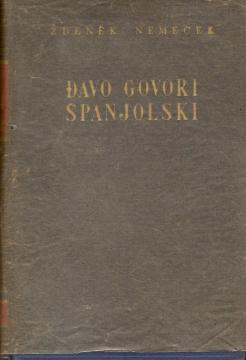
Đavo govori španjolski

Zdeněk Němeček

The novel tells a moving story about the Spanish Civil War. Through the fates of journalists, intellectuals and ordinary people, it depicts the brutality, ideological conflicts and demonic side of a war in which "the devil speaks Spanish".

The novel is inspired by and partly based on the author's own impressions and experiences from the Spanish Civil War. Němeček portrays the war not as a heroic struggle, but as a demonic tragedy in which ideologies clash, and the ordinary man becomes the victim. Through the characters of journalists, intellectuals, soldiers and civilians, the novel shows the horrors of war, terror on both sides (Franco and Republican), propaganda, betrayal and the senselessness of violence.

The title The Devil Speaks Spanish is symbolic — it suggests that in Spain at that time, evil speaks the language of passion, love and poetry, which makes it even more dangerous and insidious. Němeček does not take an open side, but critically depicts fanaticism, false ideals and suffering that war brings to everyone. The style is dynamic, reporter-like and dramatic, with strong anti-war and humanist messages.

The book was banned in Prague in 1939 after Franco's intervention, which testifies to its sharpness. It was well received in Croatia and Yugoslavia in 1940, as the Spanish Civil War was a very current topic among intellectuals.

The work is one of the most significant European novels about the Spanish Civil War written from a neutral, humanistic perspective. Today it is a rare antiquarian and sought after among lovers of interwar literature, war prose, and Czech literature.

Original title
Ďábel mluví španělsky
Translation
Marko Fotez
Editor
Slavko Batušić
Dimensions
19 x 13 cm
Pages
229
Publisher
Savremena biblioteka, Zagreb, 1940.
 
Latin alphabet. Hardcover with dust jacket.
Language: Croatian.

Two copies are available

Copy number 1

In the original cardboard box.
Condition:Unused

Copy number 2

Condition:Used, good condition (visible signs of use)
Damages or inconvenience notice:
  • Yellowed pages
  • Stains on cover
 

Are you interested in another book? You can search the offer using our search engine or browse books by category.

You may also be interested in these titles

Sarajevski Marlboro / Karivani / Druge priče, 1992–1996

Sarajevski Marlboro / Karivani / Druge priče, 1992–1996

Miljenko Jergović

Along with the reissues of "Sarajevo Marlboro" and "Karivan", the book also contains a new cycle of stories by this author. These stories vividly portray characters, "little" people, witnesses of "big" history, and seemingly insignificant, but for them pi

Durieux, 1999.
Croatian. Latin alphabet. Paperback.
14.72
Čočara

Čočara

Alberto Moravia

Widow Cesira and her daughter Rosetta flee bombed Rome to their native Ciociaria, where they experience hunger, fear and misery. Liberation brings tragedy: Rosetta is raped by Moroccan soldiers, destroying their faith in God and people.

Otokar Keršovani, 1966.
Croatian. Latin alphabet. Hardcover.
3.96
Osvajači

Osvajači

Andre Malraux

"The Conquerors" by Andre Malraux is a novel about revolutionaries, idealists, and adventurers in China in the 1920s, where the relationship between ideals, power, and human destiny is explored through political struggle, conflicts, and personal motives.

Naklada Binoza, 1932.
Croatian. Latin alphabet. Hardcover with dust jacket.
5.32 - 5.42
Deobe

Deobe

Dobrica Ćosić

Deobe is a novel about the tragic division of Serbs into Chetniks and Partisans during World War II. Winner of the NIN Award, it is part of a wider epic trilogy, inspired by Ćosić's experiences and historical documents.

Prosveta, 1963.
Croatian. Latin alphabet. Hardcover with dust jacket.
13.74
The Boat Runner

The Boat Runner

Devin Murphy

In the tradition of All The Light We Cannot See and The Nightingale, comes an incandescent debut novel about a young Dutch man who comes of age during the perilousness of World War II.

HarperCollins Publishers, 2017.
English. Latin alphabet. Paperback.
9.36
Ranjeni pejzaž

Ranjeni pejzaž

Vladimir Mičetić

A book by Vladimir Mičetić, a doctor and volunteer of the Homeland War from Kutina. The work was awarded the literary prize "We Were the First When It Was Necessary" for 2010, awarded by the Association of Croatian Homeland War Veterans.

Spiritus Movens, 2010.
Croatian. Latin alphabet. Hardcover.
11.52