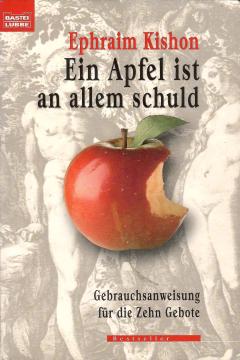
Ein Apfel ist an allem schuld
Kishon satirizes the Ten Commandments in a series of short stories. Human weaknesses, hypocrisy and futile attempts to live a consistent life according to the law are the source of comedy. The title alludes to the apple of Eden.
Ein Apfel ist an allem schuld is a humorous retelling of the Ten Commandments, translated from Hebrew into German by the author himself, along with Ursula Abrahamy and Friedrich Torberg. Kishon calls the Bible “a unique, wonderful work that transcends human comprehension,” but approaches it with the same merciless but warm satirical gift he has for all human institutions. Each commandment is given its own cycle of stories: the first on the devaluing of idols and telephone gods, the third on a chaotic holiday and a “fishnet stocking carnival,” the fifth on a series of misunderstood murders, the seventh on petty daily theft as a common folk sport, the eighth on professional false witness, the ninth on neighborly envy and squaring the circle.
The title alludes to the apple of Eden—the fruit that, according to the biblical story, causes man to fall into sin; but Kishon twists this motif: the fault lies not in the apple or in the Creator, but in the eternal human clumsiness to interpret even the clearest commandment in a way that suits it. A special charm is given by the final vignette in which the "apple worm" himself makes a defense speech against Kishon's accusation — how no one has ever so decisively shifted the blame to the apple. The pinnacle of Kishon's satirical biblical journalism, extremely popular in the German-speaking world.
One copy is available