Nikome nema povratka
Rare book
Antique

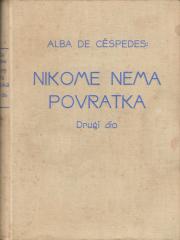
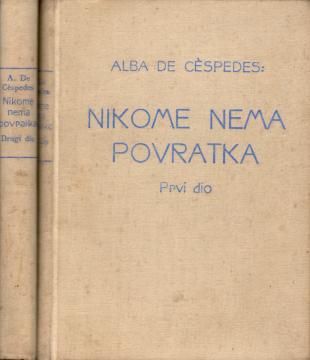
Nikome nema povratka

Alba de Céspedes

No Return (1938) follows the lives of eight young women in a Roman student dormitory, their loves, ambitions, and fates in Italian society before World War II, showing that the past cannot be returned or escaped from itself.

Alba de Céspedes (1911–1997), an Italian writer of Cuban origin, published the novel No Return, which is considered one of the most successful Italian novels of the pre-war period. The plot is set in a Roman boarding house for girls (Pensione), where eight very different students live.

The novel follows their fates over the course of a school year. Each of them represents a different social class, character and attitude to life: from idealistic and ambitious, to romantic and naive, to cynical and calculating. De Céspedes masterfully depicts their love relationships, family dramas, conflicts with their environment and gradual maturation (or decline) in Italian society under the fascist regime.

The novel is above all a deep psychological study of the female soul and the fate of women in a patriarchal society. The author subtly but clearly criticizes bourgeois morality, false reputation, class differences and restrictions imposed on women. The motif of the impossibility of return is particularly strong – decisions once made (marriage, interruption of studies, compromises) change life forever.

Alba de Céspedes' style is elegant, precise and highly psychological. The novel is rich in interior monologues and subtle descriptions of emotions. It was a huge success in Italy (over 100,000 copies in a short period of time), and was even banned by the fascist regime due to its too free depiction of female sexuality and criticism of society.

In its Croatian translation, the novel was very popular among readers who appreciated quality European psychological prose. Today, Nikome nema povrcha is considered a classic of 20th-century Italian literature and one of the most successful women's novels of its time.

Original title
Nessuno torna indietro
Translation
Ante Velzek
Editor
Ante Velzek
Dimensions
20 x 14 cm
Pages total
400
Publisher
Nakladni zavod Ante Velzek, Zagreb, 1941.
 
Latin alphabet. Hardcover.
Language: Croatian.

The book consists of two volumes.

Jedan višetomni primjerak je u ponudi.
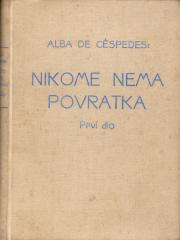
Nikome nema povratka
Volume 1
Pages: 180
Condition:Used, very good condition
Damages or inconvenience notice:
  • The cover is missing
Nikome nema povratka
Volume 2
Pages: 220
Condition:Used, very good condition
Damages or inconvenience notice:
  • The cover is missing
 

Are you interested in another book? You can search the offer using our search engine or browse books by category.

You may also be interested in these titles

Čočara

Čočara

Alberto Moravia

Widow Cesira and her daughter Rosetta flee bombed Rome to their native Ciociaria, where they experience hunger, fear and misery. Liberation brings tragedy: Rosetta is raped by Moroccan soldiers, destroying their faith in God and people.

Otokar Keršovani, 1966.
Croatian. Latin alphabet. Hardcover.
3.96
Hronika o siromašnim ljubavnicima

Hronika o siromašnim ljubavnicima

Vasco Pratolini

In Florence 1925–1926, in the poor Via del Corno, the residents live in love, poverty and fear. The arrival of fascism destroys the community: lovers fight, some die from violence, but popular solidarity survives.

Svjetlost, 1966.
Serbian. Latin alphabet. Paperback.
The book consists of two volumes
4.56
Miris noći

Miris noći

Andrea Camilleri

The Scent of the Night (2001) is part of the Inspector Salvo Montalbano series. Set in the fictional Sicilian town of Vigàtu, the novel combines crime intrigue with Camilleri's signature humor, social commentary, and vivid depictions of Sicily.

Profil Knjiga, 2011.
Croatian. Latin alphabet. Paperback.
9.327.46 - 11.36
Priča o izgubljenoj djevojčici

Priča o izgubljenoj djevojčici

Elena Ferrante

The finale of a powerful saga about female friendship that became the literary hit of the decade. Ferrante's prose is sharp, intimate - like reading a diary of the soul. It reminds us that friendship is war and peace, and the lost girl within us - the key

Profil Knjiga, 2018.
Croatian. Latin alphabet. Paperback.
14.8611.89
Pažnja

Pažnja

Alberto Moravia

Francesco Merighi returns to Rome after 9 years abroad. In order to write an "authentic" novel, he keeps a diary of his life with his wife and their daughter Babe. He obsessively analyzes lies in relationships, the temptation of

Otokar Keršovani, 1966.
Croatian. Latin alphabet. Hardcover.
3.96
Svetlosti Rima

Svetlosti Rima

Alberto Moravia

Through these stories, Moravia explores themes of social inequality, the struggle for survival, and human frailty, portraying them with a mix of humor, irony, and realistic observation.

Svjetlost, 1965.
Serbian. Latin alphabet. Paperback.
3.82 - 3.92