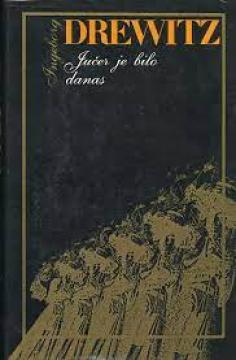
Jučer je bilo danas

Jučer je bilo danas

Ingeborg Drewitz

The novel Yesterday Was Today by German writer Ingeborg Drewitz follows the life of Gabriela, born in 1923, from childhood to old age, intertwining her personal story with the historical and social changes of the 20th century in Germany.

Through Gabriele’s portrait, the novel depicts the fates of several generations of women – her grandmother, mother and daughter Renate – depicting their struggle with patriarchal norms, war trauma and social expectations.

The plot begins in the Weimar Republic, where Gabriele grows up witnessing the rise of Nazism, World War II and post-war reconstruction. Her life is marked by losses, adjustment to bomb destruction and moral dilemmas, but also the search for her own identity. The novel deals with themes such as women’s emancipation, family relationships and conflicts between generations, as Gabriele tries to reconcile her dreams with the reality of a divided German society. Drewitz uses her story as a mirror of history, exploring how political and social events shape intimate lives.

Through a precise yet emotional style, the author emphasizes the universality of women’s experience, while at the same time criticising social structures that limit freedom. The novel is significant for German literature for its feminist approach and strong historical context, offering insight into the complexity of human destinies in turbulent times.

Original title
Gestern war heute
Translation
Mirjana Buljan
Editor
Mirjana Buljan
Dimensions
21 x 14 cm
Pages
347
Publisher
Globus, Zagreb, 1985.
 
Latin alphabet. Hardcover with dust jacket.
Language: Croatian.

Multiple copies are available

Copy number 1

Condition:Used, excellent condition

Copy number 2

Condition:Used, excellent condition

Copy number 3

Condition:Used, excellent condition
 

Are you interested in another book? You can search the offer using our search engine or browse books by category.

You may also be interested in these titles

Svjetlost se ugasila

Svjetlost se ugasila

Rudyard Kipling

The first novel by English Nobel Prize winner Rudyard Kipling (1865–1936), first published in Lippincott's Monthly Magazine (happy ending variant), and then in a book version with a tragic ending.

Zora, 1957.
Croatian. Latin alphabet. Hardcover with dust jacket.
5.42
Kreutzerova sonata, Hadži-Murat

Kreutzerova sonata, Hadži-Murat

Lav Nikolajevič Tolstoj

Kreutzer's sonata belongs to those works of Tolstoy that the writer adapted in many ways to his view on moral issues, on marital morality above all.

Civitas, 2004.
Croatian. Latin alphabet. Paperback.
4.98
Provincijalac

Provincijalac

Momo Kapor

As much as Foliranti is a story about Kapor's student days in Belgrade in the late fifties, Provincial is a book that evokes memories of his childhood in Sarajevo, where the author spent the first years of his life.

Znanje, 1984.
Serbian. Latin alphabet. Paperback.
5.32
Triologija: Molloy, Malone umire, Neimenjivi

Triologija: Molloy, Malone umire, Neimenjivi

Samuel Beckett

He has marked the contemporary era like few others, and his heroes or "heroes" with their emotional and moral dilemmas, weighed down by existential anxiety and news of cataclysms and possible apocalypses, are closer to us than ever.

Šareni dućan, 2014.
Croatian. Latin alphabet. Hardcover.
29.38
Pažnja

Pažnja

Alberto Moravia

Francesco Merighi returns to Rome after 9 years abroad. In order to write an "authentic" novel, he keeps a diary of his life with his wife and their daughter Babe. He obsessively analyzes lies in relationships, the temptation of

Otokar Keršovani, 1966.
Croatian. Latin alphabet. Hardcover.
3.96
Rock Star

Rock Star

Jackie Collins

With the rhythm of rock'n'roll, Jackie Collins takes the reader behind the scenes of the world of fame and fortune, where three music stars — Kruger, Rafaella and Bobby — experience turbulent passions, betrayals and the struggle for success, while ambitio

Mladost, 1990.
Croatian. Latin alphabet. Hardcover with dust jacket.
9.34